

Jamaica launches JAMRROC to watch the watchdog as Holness demands faster hurricane recovery
Jamaica Live News Desk– | Sept 9, 2026
KINGSTON, Jamaica — September 8, 2026: Prime Minister Dr Andrew Holness has officially launched the Jamaica Reconstruction and Resilience Oversight Committee (JAMRROC), establishing an independent layer of public oversight as the Government attempts to accelerate Jamaica’s massive reconstruction programme following the devastation caused by Hurricane Melissa.
The committee was formally launched at Jamaica House on Tuesday, with Holness making it clear that while he is deeply dissatisfied with the pace at which some hurricane victims are receiving assistance, the urgency to rebuild cannot come at the expense of transparency and accountability.
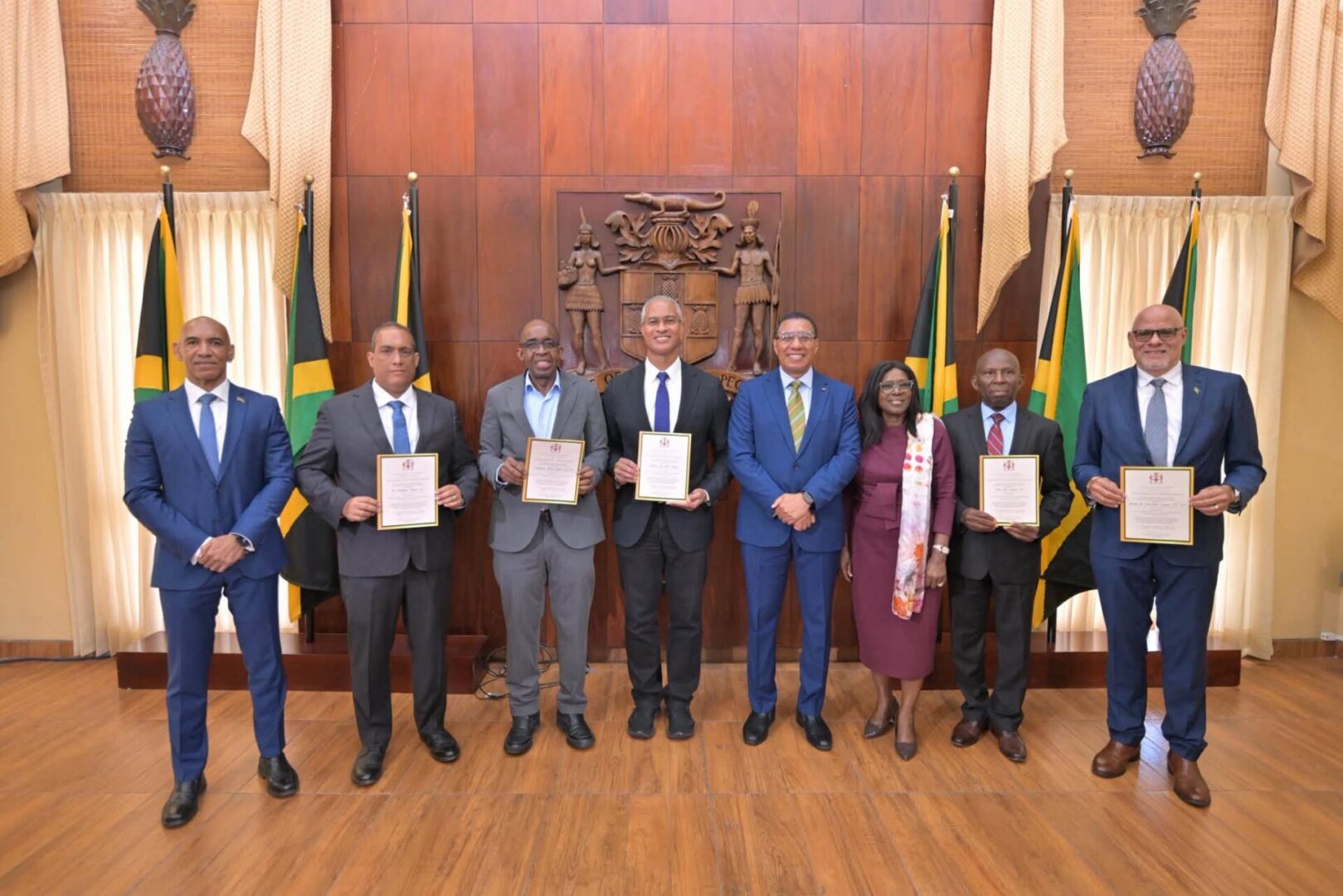
JAMRROC will scrutinise the work of the National Reconstruction and Resilience Authority (NaRRA), the Government’s central body for coordinating major post-disaster reconstruction and longer-term resilience projects.
The committee is chaired by internationally recognised Jamaican economist Professor Peter Blair Henry, Senior Fellow at Stanford University’s Hoover Institution and former Dean of New York University’s Stern School of Business.
Its members are Senator Keith Duncan; Patrick Hylton; Helene Davis Whyte; Pastor Glen Samuels; Dr Christopher Burgess; and Ambassador Professor Dale Webber. Burgess was nominated by Opposition Leader Mark Golding, providing Opposition representation on the oversight body.
The inclusion of an Opposition nominee is particularly significant given the political disagreements that have surrounded the establishment and structure of NaRRA.
Professor Henry praised Golding’s decision to nominate Burgess, arguing that the Opposition Leader could have selected a symbolic representative but instead chose someone whose expertise could contribute substantively to the committee’s work.
JAMRROC’s two critical jobs
JAMRROC will have two major responsibilities.
First, it will advise the Prime Minister and Cabinet on which reconstruction projects should be selected for NaRRA’s accelerated process. The committee is expected to assess projects not simply according to political or local demands, but also according to their economic, social and resilience value.
Where projects are commercially viable, JAMRROC is also expected to help encourage the mobilisation of private capital — both Jamaican and international — alongside support from international development partners.
Second, JAMRROC will independently monitor and assess NaRRA’s performance, including whether reconstruction projects are being delivered on time and within budget.
The committee is expected to report publicly on the reconstruction programme, giving Jamaicans an independent mechanism through which they can assess whether promises are translating into completed projects.
Professor Henry has indicated that JAMRROC intends to issue quarterly public updates, establish a public website and conduct community outreach, including engagement in western Jamaica, the region hardest hit by Hurricane Melissa.
Holness: I am not satisfied
The launch came with a striking admission from Prime Minister Holness: nearly a year after Hurricane Melissa, he is not satisfied with the pace of recovery.
Holness pointed specifically to housing.
He recalled that approximately six weeks after the hurricane, commitments were made to purchase modular and semi-permanent housing solutions for affected families. Yet, almost a year after the disaster, contracts were only now being signed and houses beginning to be delivered.
For families still living in extremely difficult circumstances, the Prime Minister acknowledged that explanations about government procedures offer little comfort.

Some affected Jamaicans, he said, are still waiting for proper shelter.
The Prime Minister argued that Jamaica must confront a bureaucratic culture in which moving quickly can itself become viewed with suspicion.
Public officials, he suggested, can become reluctant to accelerate projects because they fear being accused of bypassing procedures or later facing criticism from parliamentary oversight bodies or the Auditor General.
Holness said Jamaica must reject the assumption that a project completed quickly must necessarily have been improperly executed.
At the same time, however, he insisted that urgency cannot become an excuse for abandoning safeguards surrounding public money.
“Speed without accountability is equally unacceptable,” the Prime Minister declared.
For an undertaking involving substantial public resources, he said, the faster the Government moves, the greater the need for credible scrutiny.
NaRRA remains subject to Jamaica’s accountability system
Holness also pushed back against suggestions that NaRRA operates outside Jamaica’s established accountability framework.
The Prime Minister stressed that the authority remains subject to statutory and parliamentary scrutiny, while JAMRROC adds another continuous and publicly visible level of oversight.
NaRRA was formally established in law earlier this year to coordinate and accelerate Jamaica’s reconstruction and resilience programme.
Its mandate goes far beyond simply replacing buildings and infrastructure destroyed by Hurricane Melissa.
The Government has presented NaRRA as a mechanism for “building back better” — reconstructing roads, bridges, schools, health facilities and communities to standards capable of better withstanding future hurricanes, flooding and other climate-related disasters.
Among the areas previously identified for the wider reconstruction programme are damaged infrastructure, roads, bridges and drainage systems; schools and health facilities; relocation or reconstruction of vulnerable communities in high-risk areas; and the climate-resilient redevelopment of major urban centres.
The Government has also identified major national development projects that could form part of the broader reconstruction and resilience strategy.
The enormous cost of Hurricane Melissa
The scale of the challenge facing JAMRROC and NaRRA is enormous.
Hurricane Melissa made landfall near New Hope, Westmoreland, on October 28, 2025, as a Category 5 hurricane, devastating communities across western and southwestern Jamaica.
According to figures contained in the legislation establishing NaRRA, the Planning Institute of Jamaica estimated total hurricane-related damage and losses at approximately J$1.952 trillion, or US$12.2 billion.
That figure was equivalent to approximately 56.7 per cent of Jamaica’s 2024 gross domestic product and more than four times the losses associated with Hurricane Gilbert, previously regarded as Jamaica’s costliest hurricane.
The sheer scale of the destruction forced the Government to rethink how Jamaica undertakes disaster reconstruction.
Rather than rebuilding damaged assets through numerous disconnected ministries and agencies, NaRRA is intended to operate as a central coordinating mechanism capable of reducing duplication and bureaucratic delays.
A watchdog watching Jamaica’s reconstruction authority
JAMRROC therefore occupies an unusual but important position.
NaRRA is the institution designed to move reconstruction faster.
JAMRROC is the institution designed to make sure that moving faster does not mean abandoning accountability.
The Government has compared the model to Jamaica’s Economic Programme Oversight Committee (EPOC), which independently monitored the country’s economic reform programme and became an important mechanism for building public confidence in Jamaica’s fiscal reforms.
JAMRROC is expected to perform a similar role, but at a far more detailed project level.
The committee will not build roads or houses itself. Instead, it will examine what NaRRA is doing, measure progress against established targets and make its assessment available to the public.
That distinction will be crucial.
For JAMRROC to establish credibility, Jamaicans will need to see more than meetings, reports and announcements. The public will expect clear information showing which projects have been approved, how much they cost, who is responsible for delivering them, when they are expected to be completed and whether those deadlines and budgets are being met.
International support
Jamaica’s reconstruction programme is also receiving substantial international attention.
At the JAMRROC launch, representatives from international and multilateral partners were present, reflecting the importance of external financing and technical support to the rebuilding programme.
The European Union has provided a US$5 million grant, channelled through the World Bank, to assist with the early establishment and work of NaRRA.
The Government has previously indicated that Jamaica has access to a multilateral financing framework amounting to billions of US dollars for reconstruction and resilience initiatives.
But the magnitude of those resources makes oversight even more important.
As billions are mobilised for rebuilding, Jamaicans will expect safeguards against waste, cost overruns, political favouritism and poorly conceived projects.
From recovery to resilience
The Government’s stated ambition is not simply to restore Jamaica to where it was on October 27, 2025 — the day before Melissa made landfall.
The objective is to use reconstruction to address vulnerabilities that existed long before the hurricane.
That includes stronger infrastructure, improved drainage, safer housing, better land-use planning and the relocation or redevelopment of communities that remain dangerously exposed to hurricanes, flooding and other climate threats.
Holness has directed that the relocation of vulnerable communities be treated as a priority reconstruction initiative, while stressing that affected residents should be consulted and treated with dignity and fairness.
This represents one of the most difficult questions Jamaica will confront during the reconstruction process.
Rebuilding a house in the same highly vulnerable location may restore what was lost, but it does little to protect the family when the next major hurricane arrives.
True resilience may therefore require politically difficult decisions about where and how Jamaicans live.
The real test begins now
The launch of JAMRROC adds another major piece to Jamaica’s post-Melissa reconstruction machinery.
NaRRA has been given the responsibility and legal authority to help accelerate rebuilding. JAMRROC has now been established to independently scrutinise that work and help ensure that urgency does not undermine accountability.
Professor Henry and his committee therefore inherit an enormous responsibility.
For thousands of Jamaicans still recovering from Hurricane Melissa, however, the ultimate measurement of success will not be another committee, another authority or another report.
It will be homes rebuilt, schools reopened, roads repaired, communities made safer and public money accounted for.
Prime Minister Holness has acknowledged that the current pace is not good enough.
JAMRROC’s challenge is now to help ensure that Jamaica can move faster — without sacrificing the transparency, discipline and accountability required when billions of dollars and the future resilience of the country are at stake.
Jamaica Live – Your trusted news source both locally and internationally.