
NWC Seeks 51% Water Rate Increase Amid Mounting Debt and Infrastructure Investment Needs
Jamaica Live News Desk– | Oct 20, 2026
KINGSTON, JAMAICA — Approximately 500,000 customers of Jamaica’s National Water Commission (NWC) could face significantly higher water bills after the government-owned utility submitted an application seeking a 51 per cent increase in its rates.
The proposal, disclosed during Tuesday’s sitting of Parliament’s Public Accounts Committee (PAC), raises important questions about the financial position of the NWC, the cost of supplying water across Jamaica, and the potential impact on households already grappling with the cost of living.
Although the proposed increase has not been approved, its scale is likely to attract considerable public attention, particularly among customers who have raised concerns about high water bills and inconsistent service.
Why Is the NWC Seeking a 51% Increase?
Acting NWC President Kevin Kerr confirmed that the commission submitted its application to the Office of Utilities Regulation (OUR) on Friday, 16 October 2026.
Kerr explained that the request is linked to an investment plan intended to secure financing for priority infrastructure projects.
“There is an investment plan aligned to that tariff submission to ensure that the financing can be secured so we can execute on the priority initiatives in that plan.”
He also indicated that if the full 51 per cent increase is not approved, the NWC would have to revise its investment plan.
The commission maintains that additional revenue is necessary to bring its income more closely into line with its expenditure.
NWC Chief Financial Officer Fabian Christie told the parliamentary committee that the company’s revenue position had deteriorated over time, particularly regarding customer payments.
He identified rising operational expenses, including electricity costs, as contributing factors behind the application.
Electricity represents a significant expense for the NWC, which relies on electrically powered systems to extract, treat, pump and distribute water across Jamaica.
The company is also responsible for maintaining ageing infrastructure, repairing leaks, improving distribution networks and expanding services to underserved communities.
However, while these challenges help explain the commission’s financial pressures, the precise calculations supporting the requested 51 per cent increase have not yet been publicly established in the reports reviewed by Jamaica Live.
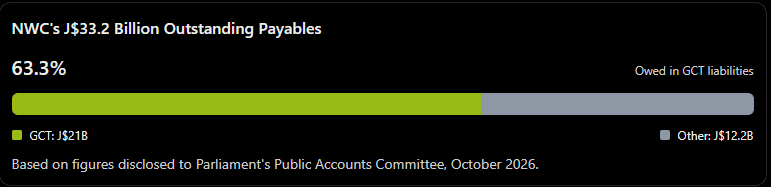
NWC’s J$33 Billion Debt Raises Questions About Proposed Rate Increase The proposed 51 per cent water-rate increase comes amid revelations that the National Water Commission has accumulated approximately J$33.2 billion in outstanding financial obligations, including J$21 billion in General Consumption Tax (GCT) liabilities owed to the Government of Jamaica.
The figures were discussed during Tuesday’s meeting of Parliament’s Public Accounts Committee, where NWC Chief Financial Officer Fabian Christie addressed findings contained in an Auditor General’s report.
According to the report, the NWC’s outstanding payables increased from J$10.6 billion in 2016/2017 to J$33.2 billion by March 2026, reflecting persistent liquidity and revenue collection challenges.
Although the commission’s financial performance improved from a J$5.7 billion loss in 2019/2020 to a reported J$200 million profit in 2023/2024, this did not translate into stronger cash availability.
Of particular significance is that approximately 63 per cent of the NWC’s reported outstanding obligations relate to GCT liabilities owed to the Government.
The findings raise an important question: To what extent would additional revenue from the proposed rate increase be used to address existing financial obligations, rather than exclusively financing infrastructure improvements and operational expenses?
While the NWC has cited rising costs and investment requirements as reasons for the proposed increase, a detailed breakdown of how the additional revenue would be allocated would provide greater clarity for consumers.
How Much Are Jamaicans Already Paying for Water?
Water bills vary considerably depending on household consumption, meter size, sewerage services and additional charges.
Under the NWC’s published rates effective 6 May 2026, a standard residential connection with a 5/8-inch meter carries a monthly service charge of J$1,272.90.
That amount is separate from the charges associated with water consumption, sewerage services and applicable adjustments.
For residential customers using imperial meters, the published water consumption rate for the first 3,000 gallons is J$737.12 per 1,000 gallons, while sewerage charges, where applicable, are calculated separately.
Consequently, the final amount appearing on a customer’s bill can be considerably higher than the basic service charge.
A verified national average residential water bill has not yet been established for this report.
What Could a 51% Increase Mean for Households?
If the proposed increase translated into a corresponding 51 per cent rise in an entire monthly bill, the financial implications could be substantial.
For illustration:
| Current monthly bill | Bill after 51% increase |
|---|---|
| J$2,000 | J$3,020 |
| J$3,000 | J$4,530 |
| J$5,000 | J$7,550 |
| J$8,000 | J$12,080 |
| J$10,000 | J$15,100 |
These figures are hypothetical. The actual impact would depend on the final rate structure approved by the OUR, including how individual billing components are treated.
Nevertheless, the examples demonstrate why the proposed increase warrants careful public examination.
Jamaicans Already Pay a Price Adjustment Charge
One particularly important consideration is that the NWC already operates a Price Adjustment Mechanism (PAM), which allows water bills to reflect changes in certain operating costs.
The mechanism takes account of three principal factors:
- Inflation, measured through the Consumer Price Index.
- Changes in electricity prices.
- Movements in the Jamaican dollar against the United States dollar.
The mechanism can result in upward or downward adjustments depending on movements in these indices.
In addition, the NWC’s published billing framework includes a K-Factor and an X-Factor, which affect the calculation of charges.
According to the commission’s May 2026 rate schedule, the K-Factor is 20 per cent and the X-Factor is negative 5 per cent.
These existing mechanisms raise an important question: If the NWC already adjusts customers’ bills to account for inflation, electricity costs and foreign exchange movements, what additional financial requirements justify a further 51 per cent increase?
The answer may involve infrastructure investment, revenue shortfalls and expenses not adequately covered by existing adjustments.
However, a detailed breakdown would help customers understand the necessity and scale of the proposal.
Who Owns the NWC, and Who Will Approve the Increase?
The National Water Commission is a statutory public utility established under Jamaican law. It is government-owned and provides water and sewerage services across much of the island.
However, the NWC does not have unrestricted authority to determine the rates customers must pay.
That responsibility rests with the Office of Utilities Regulation, an independent statutory regulatory authority established to oversee prescribed utility services in Jamaica.
The OUR regulates water and sewerage providers and has the legal authority to determine applicable rates and service standards.
This means the current application involves two distinct public institutions: a government-owned utility requesting additional revenue and a government-established regulator responsible for examining the justification.
The OUR must assess the proposal before determining whether to approve, reject or modify the requested increase.
Importantly, Kerr indicated that members of the public would have an opportunity to participate in a consultation process before the regulator reaches its decision.
Has the NWC Increased Water Rates Before?
According to information presented to Parliament, the NWC last received approval for a general tariff increase in 2019.
However, that does not mean customers’ bills have remained unchanged since then.
The existing Price Adjustment Mechanism and annual adjustments to base rates have continued to affect billing.
For example, in 2023, the OUR confirmed a 5.11 per cent adjustment to the NWC’s base rates under its Annual Price Adjustment Mechanism.
The regulator explained that this was not a separate general rate increase but an adjustment incorporating previously accumulated monthly price changes into the base tariff.
This distinction is significant because customers may have experienced changes in their bills even without a newly approved general tariff increase.
Will Higher Water Bills Guarantee Better Service?
Beyond the financial implications, the proposed increase raises questions about service delivery.
For customers who experience intermittent water supply, low pressure, leaks or prolonged interruptions, the prospect of higher bills may naturally prompt questions about what improvements they can expect in return.
The NWC has linked its proposal to priority infrastructure investments, but the public will need to understand which projects are included, how much they will cost and when improvements are expected.
Greater transparency regarding the company’s financial performance, operational efficiency, infrastructure losses and investment priorities would also help inform the public debate.
Not All Customers Oppose the Proposed Increase
While the proposed 51 per cent increase may raise affordability concerns, at least some customers recognise the need for continued investment in Jamaica’s water infrastructure.
One Jamaican resident, speaking directly with Jamaica Live, disclosed that their current monthly water bill is approximately J$5,000, an amount they do not consider particularly expensive.
The resident also described observing significant infrastructure work, including the installation of new water pipes, and expressed an understanding of why additional investment might be necessary.
Although an increase would mean paying considerably more each month, the resident indicated that the visible improvements made the proposal more understandable and that they were not personally opposed to higher charges.
The account offers another perspective on the proposed increase, highlighting the importance of examining not only affordability but also whether customers are seeing tangible improvements in the services they receive.
What Happens Next?
The Office of Utilities Regulation is expected to examine the NWC’s application and facilitate public consultation before making its determination.
Until that process is completed, the proposed 51 per cent increase remains a request rather than an approved adjustment.
The regulator may approve the requested increase, authorise a smaller adjustment or reject the application based on its assessment.
For approximately half a million NWC customers, the outcome could have important implications for household expenditure.
The central questions now concern the financial justification for the proposed increase, the affordability of water services and the improvements Jamaicans can reasonably expect if they are required to pay more.
Jamaica Live will continue to follow developments surrounding the NWC’s application, including the OUR’s review and opportunities for public participation.