

Did Democratic Socialism Fail Jamaica? Or Did the Cold War Change Jamaica Forever?
JAMAICA LIVE | SPECIAL ANALYSIS
Opposition Leader Mark Golding has reopened one of the most consequential and painful debates in Jamaica’s modern political history by embracing democratic socialism and invoking the legacy of former Prime Minister Michael Manley.
Golding argues that changing economic conditions have renewed the relevance of the philosophy and that government should place the interests and basic needs of ordinary people at the centre of national development. Prime Minister Andrew Holness subsequently picked up the debate and went directly to the history Golding had invoked.
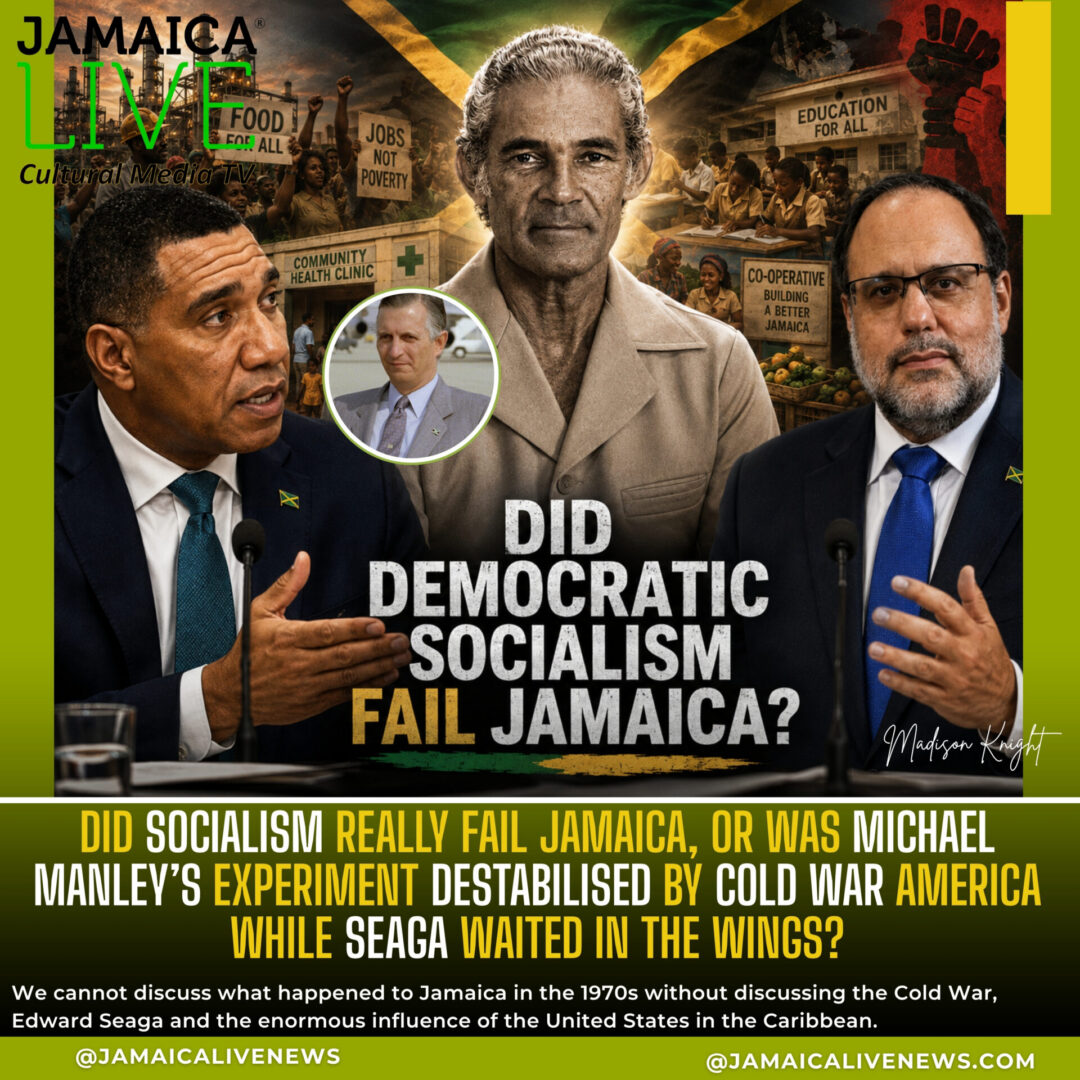
Speaking during a joint sitting of Parliament, Holness argued that between 1972 and 1980, Manley’s embrace of democratic socialism, closer relationship with Fidel Castro’s Cuba, participation in the Non-Aligned Movement and engagement with socialist and communist countries represented a fundamental and ultimately disastrous shift in Jamaica’s political, economic and foreign-policy direction.
Holness said Manley placed Jamaica “in the crossfire of a power struggle between superpowers” and linked that period with the collapse of the economy, Jamaica’s first major debt crisis, the hollowing out of the middle class and the emergence of widespread political and gang violence.
Holness’ central question was therefore a legitimate one: if Manley himself eventually changed course, why did Jamaica embark on democratic socialism in the first place?
It is a question worth examining. But the answer is considerably more complicated than the proposition that socialism was tried and simply failed.
A country caught in the Cold War
There is little dispute that Jamaica experienced severe economic deterioration during the 1970s. Manley’s administration must bear responsibility for decisions made during that period, including policies that damaged investor confidence and contributed to uncertainty within the private sector.
However, Jamaica’s economic crisis cannot reasonably be separated from the international environment in which it occurred.
The Cold War was not an abstract conflict taking place thousands of miles away. The Caribbean had become one of its strategic theatres following the Cuban Revolution, and Jamaica’s geographical proximity to Cuba and the United States made Manley’s foreign policy particularly consequential.
Socialism was not Jamaica’s fundamental problem. Michael Manley was not Jamaica’s fundamental problem.
There is considerable truth in Holness’ description of what Jamaica experienced. Where this analysis differs fundamentally is in why it happened. The economic catastrophe of the 1970s cannot honestly be explained by beginning with Michael Manley embraced democratic socialism and ending with Jamaica collapsed.
Manley strengthened relations with Fidel Castro, expanded Jamaica’s engagement with socialist countries and became an influential voice within the Non-Aligned Movement. At home, his administration pursued policies intended to increase Jamaica’s control over its resources and extract greater benefits from foreign-owned industries, most notably the bauxite sector.
These decisions inevitably attracted Washington’s attention.
The tragedy was that a small, economically vulnerable Caribbean island attempted to pursue an independent socialist-oriented economic and foreign policy at the height of the Cold War while developing close relations with Cuba and the socialist world.
And the United States was never going to regard that development with indifference.
Jamaica stepped directly into the Cold War
To understand what happened, Jamaica must first understand the world in which Michael Manley was governing.
The United States and Soviet Union were engaged in a global struggle for political, military and economic influence. Cuba, following its 1959 revolution, had become Washington’s principal communist adversary in the Caribbean.
Then came Michael Manley.
Manley strengthened relations with Cuba, challenged foreign corporate interests, dramatically increased the bauxite levy, pursued greater Jamaican participation in the country’s resources and became an influential voice within the Non-Aligned Movement.
Whatever one thinks of those decisions, Jamaica had every sovereign right to make them.
But sovereignty and geopolitical power are two different things.
Jamaica was a small island situated in a region the United States considered strategically important, while Manley was developing increasingly close relationships with governments Washington regarded as adversaries.
Declassified American records show that U.S. officials closely monitored Manley’s relationship with Cuba, his economic programme and the possibility that Jamaica could move further towards the Soviet and Cuban sphere of influence.
187. Telegram From the Embassy in Jamaica to the Department of State1
Kingston, May 16, 1978, 1204Z
4030. From Ambassador. Subject: Seaga Asserts Assistance Keeping Manley in Power.
1. Opposition leader Edward Seaga sent his political confidant, Senator Ronald Irvine, to see me with a message this morning (May 15). Irvine said that Seaga was urging that major bilateral aid donors temporarily suspend their assistance to Jamaica. Irvine went on to say that continued provision of aid would not be used effectively as long as Michael Manley remains in office but would have the sole result of “propping up” the Prime Minister. What Jamaica needs now, said Irvine on Seaga’s behalf, is the removal of Michael Manley. Only then can any kind of credibility be restored to the Government of Jamaica. (Irvine subsequently said that he had already made Seaga’s views known to the British High Commissioner.)
That is important because it establishes that Jamaica’s political direction was not simply a domestic matter in the eyes of the world’s most powerful country. Jamaica had become part of the Cold War.
The United States was never going to simply ignore Cuba!
This is the uncomfortable geopolitical reality that must sit at the centre of this discussion.
The United States was never going to quietly accept the possibility of Jamaica moving decisively into the political orbit of Cuba and the Soviet Union at the height of the Cold War.
Manley may have believed—and correctly—that an independent Jamaica had the sovereign right to maintain diplomatic and economic relationships with whichever countries it chose. But Jamaica did not possess the economic, military or geopolitical strength to compel a superpower to accept those decisions without consequence.
That was Manley’s great miscalculation.
Not believing in social justice.
Not believing poor Jamaicans deserved education.
Not believing workers deserved greater protection.
Not believing Jamaica should receive greater benefits from its own natural resources.
His miscalculation was believing that Jamaica possessed sufficient economic strength to challenge the prevailing geopolitical order and survive the confrontation relatively intact.
It did not.
Guns, blood and hunger
For Jamaicans who experienced the 1970s, however, this was never an academic debate about capitalism and socialism.
It was lived in communities, supermarkets, workplaces and homes.
Guns, blood and hunger became part of Jamaica’s political reality.
The country experienced severe foreign-exchange shortages. Imports were restricted. Basic goods became increasingly difficult to obtain.
Capital fled. Investment declined. Businesses struggled.
At the same time, Jamaica’s political conflict became increasingly militarised. Communities were divided according to political allegiance. Armed political enforcers became fixtures of partisan politics. Territory, housing, government patronage and political loyalty became dangerously intertwined.
The People’s National Party (PNP) and the Jamaica Labour Party (JLP) both became associated with armed political gangs and fiercely partisan communities. The violence ultimately reached horrifying proportions.
By the 1980 general election campaign, more than 800 Jamaicans were reportedly killed in politically motivated violence between February and October alone.
That figure should stop us in our tracks. Eight hundred people. This was happening in a country with a population of roughly two million. It was not ordinary electoral competition.
Jamaica was tearing itself apart.
Political gunmanship changed Jamaica
The significance of this period extends far beyond who won the 1980 election. The political gun culture that developed and hardened during the 1970s helped transform Jamaica. Political parties became deeply connected to territorial communities. Armed political actors acquired power within those communities. Patronage, housing, political allegiance and access to state resources became intertwined. Those structures did not simply disappear when the election ended.
The political violence of the 1970s and 1980s became part of the environment from which Jamaica’s later garrison politics and organised criminal networks developed. The Cold War eventually ended. The guns remained. The political leaders eventually changed. The communities remained. And criminal organisations increasingly developed their own sources of money and power. That is one reason this period cannot simply be reduced to an argument over GDP or economic ideology.
It changed the trajectory of Jamaica.
Then there was the fear of communism
Another weapon was fear. Jamaicans were repeatedly warned that communism was coming to Jamaica. Cuba became the symbol of what many Jamaicans were told their country would become. The fear was particularly powerful among sections of the professional, business and middle classes. And people responded. Money left Jamaica. Businesses and investors withdrew. Professionals migrated. Families packed their belongings and left for the United States, Canada, Britain and elsewhere. Jamaica consequently suffered two forms of capital flight simultaneously:
financial capital and human capital. Doctors, nurses, teachers, entrepreneurs, professionals and skilled Jamaicans became part of a migration wave whose consequences continued long after the political conflict subsided. This was not an insignificant side effect of the political struggle. It helped reshape Jamaican society.
For some Jamaicans, the 1970s exist primarily in history books, political speeches and economic statistics. For others of us, it is memory. But neither should the lived experiences of Jamaicans who survived this period be dismissed simply because decades have passed. When we discuss whether socialism “failed,” we are discussing something that profoundly altered families, communities and the direction of an entire country.
Edward Seaga cannot be removed from the history
This brings us to another uncomfortable part of the conversation. Prime Minister Holness says Jamaica has not sufficiently “ventilated” this period. He is right.
But we cannot ventilate Michael Manley while leaving Edward Seaga outside the room.
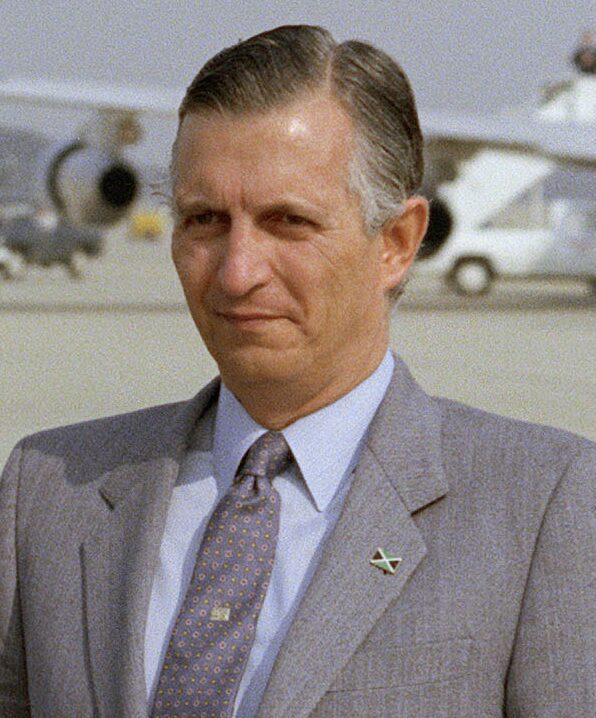
A confidential May 16, 1978 telegram from the U.S. Embassy in Kingston records an extraordinary intervention by the Jamaican Opposition. According to Ambassador Frederick Irving, Seaga sent his political confidant, Senator Ronald Irvine, to deliver a message. Seaga wanted Jamaica’s major bilateral aid donors to temporarily suspend their assistance to Jamaica. Why? Because continued assistance, according to the message conveyed on his behalf, was “propping up” Michael Manley. Irvine delivered Seaga’s desired political outcome explicitly:
“What Jamaica needs now…is the removal of Michael Manley.”
Consider that carefully. Jamaica was experiencing an economic crisis. Foreign exchange was scarce. The country desperately needed international financing. Yet the Opposition leader was, through his confidant, encouraging major foreign governments to temporarily withhold assistance from Jamaica because that assistance might help keep his political opponent in government.
Perhaps the greatest irony is that the American ambassador rejected the proposal. Irving told Irvine that American assistance was intended to help Jamaica and that Washington would not deliberately harm the Jamaican people merely to achieve a short-term political objective. That document fundamentally complicates the claim that Jamaica’s economic deterioration can simply be laid at the feet of Michael Manley and democratic socialism.
If we are examining what Manley did while Jamaica’s economy deteriorated, then we must also examine what Seaga was doing.
Washington considered helping to defeat Manley
Then comes an even more consequential document. In 1979, the CIA prepared a secret memorandum titled “Covert Action Options for Jamaica.” The objective stated in that American government document is remarkable. It proposed measures designed to counter Cuban and Soviet influence over Jamaica and said the ultimate American objective was either the political defeat of Michael Manley and his replacement by a government friendlier to the United States, or sufficient pressure on Manley to force him to moderate his foreign policy, particularly his relationships with Cuba and the Soviet Union.
One proposed option was direct confidential contact with Edward Seaga. The document contemplated providing guidance, assistance and funds to the JLP for the coming election campaign. Another option contemplated covert information activity condemning Manley’s relationship with Cuba and the Soviet Union. This is not folklore. It is not political gossip. And it is not something invented decades later by Manley supporters.
It is contained in the declassified foreign-policy records of the United States government. The American government was formally considering whether it should secretly assist the Jamaican Opposition in order to defeat the democratically elected government of Michael Manley or force a change in Jamaican foreign policy.
That fact belongs at the centre—not the margins—of any serious discussion about Jamaica and the Cold War.
What about the guns?
This is perhaps the darkest and most contested area of the history. Weapons flooded Jamaica’s political communities during this period. Both political sides developed armed gangs, and allegations of foreign involvement—including claims involving American weapons and CIA activity—became part of the political conflict. Declassified U.S. documents also contain American allegations that PNP activists received training and weapons from Cuba.
Manley was fighting two battles
Michael Manley therefore faced two interconnected struggles. One was economic. The other was geopolitical. His government was trying to finance an ambitious programme of social development while Jamaica was suffering from oil shocks, declining investment, capital flight, foreign-exchange shortages, weaker export performance and deteriorating access to international financing. At the same time, Manley was navigating a hostile Cold War environment in which Washington viewed his relationship with Cuba and the Soviet-aligned world with deep suspicion.
Manley came back a changed man
Holness makes one particularly important observation. When Michael Manley returned to power in 1989, he had changed. He pursued constructive relations with Washington. He accepted Jamaica’s international debt obligations. He worked with the IMF and other international financial institutions. He embraced greater private-sector participation, liberalisation and a more market-oriented economic programme.
Holness interprets Manley’s transformation as proof that democratic socialism had failed. There is another interpretation.
Michael Manley had learned what Jamaica could survive. There is a profound difference. Manley did not need to stop believing that poor Jamaicans deserved education. He did not need to stop believing in healthcare. He did not need to stop believing in workers’ rights. He did not need to stop believing that Jamaica’s resources should benefit Jamaicans.
He needed to recognise that a small developing country could not simultaneously fight an economic crisis and wage an ideological confrontation with the dominant power in the Western Hemisphere. He returned to office as a pragmatist. Perhaps that was not the abandonment of Michael Manley’s principles. Perhaps it was Michael Manley finally understanding the limitations of Jamaican power.
Jamaica cannot fight the United States
And here we arrive at an uncomfortable truth that ideological politics often refuses to acknowledge. Jamaica could not afford to fight United States foreign policy in the 1970s, and Jamaica cannot afford to do so today. That is not an argument for subservience. Jamaica is sovereign. Jamaica should determine its own foreign policy. Jamaica should maintain relationships with China, the United States, Europe, Africa, Latin America, the Caribbean and whichever nations advance Jamaican interests.
But sovereignty does not abolish geopolitical reality. A country of Jamaica’s size cannot recklessly position itself in direct confrontation with vastly more powerful economic nations and then pretend there will be no consequences. Anyone encouraging Jamaica to believe otherwise is either ignoring history or inviting the country to repeat it. Michael Manley learned that lesson painfully. Jamaica should not have to learn it again.
So was democratic socialism really the problem?
This brings us back to the argument Mark Golding started. Democratic socialism does not automatically mean communism. It does not require abolishing private property. It does not require government ownership of every business. And it should not be lazily reduced to the idea of government simply confiscating and “redistributing wealth.” For Jamaica, democratic socialism can mean something considerably more practical.
It can mean accepting that a civilised society establishes a basic standard of living beneath which its citizens should not be allowed to fall.
That means healthcare. Education. Housing. Transportation. Food security. Pensions. Social protection.And genuine economic opportunity. Those things must be financed. That generally means taxation—including a system in which people and businesses with greater economic capacity contribute accordingly—and using those revenues efficiently to provide the public infrastructure and social services necessary for ordinary Jamaicans to live with dignity. Private enterprise can still flourish. Entrepreneurs can become wealthy. Foreign investors can earn profits. Jamaicans can own businesses and accumulate wealth. The state does not have to destroy capitalism to establish a social floor.
Indeed, Jamaica already accepts this principle through public education, public healthcare, the National Housing Trust and other social programmes. So, the question, remains, what changes would Mark Golding make to the current system and would he be more incline to move towards a Democratic Socialist model?!