

Is the United Kingdom Breaking Apart? Scotland, Wales and Northern Ireland Leaders Unite in Referendum Push
Jamaica Live International News– | Sept 13, 2026
CARDIFF, Wales — The political future of the United Kingdom is facing renewed scrutiny as the leaders of Scotland, Wales and Northern Ireland prepare for an unprecedented meeting in Cardiff on Monday, September 14, where they are expected to sign a joint declaration asserting their nations’ right to self-determination and to hold referendums on their constitutional futures.
The meeting will bring together Scottish First Minister and Scottish National Party (SNP) leader John Swinney, Welsh First Minister and Plaid Cymru leader Rhun ap Iorwerth, and Northern Ireland First Minister and Sinn Féin vice-president Michelle O’Neill. Sinn Féin president Mary Lou McDonald is also expected to participate.
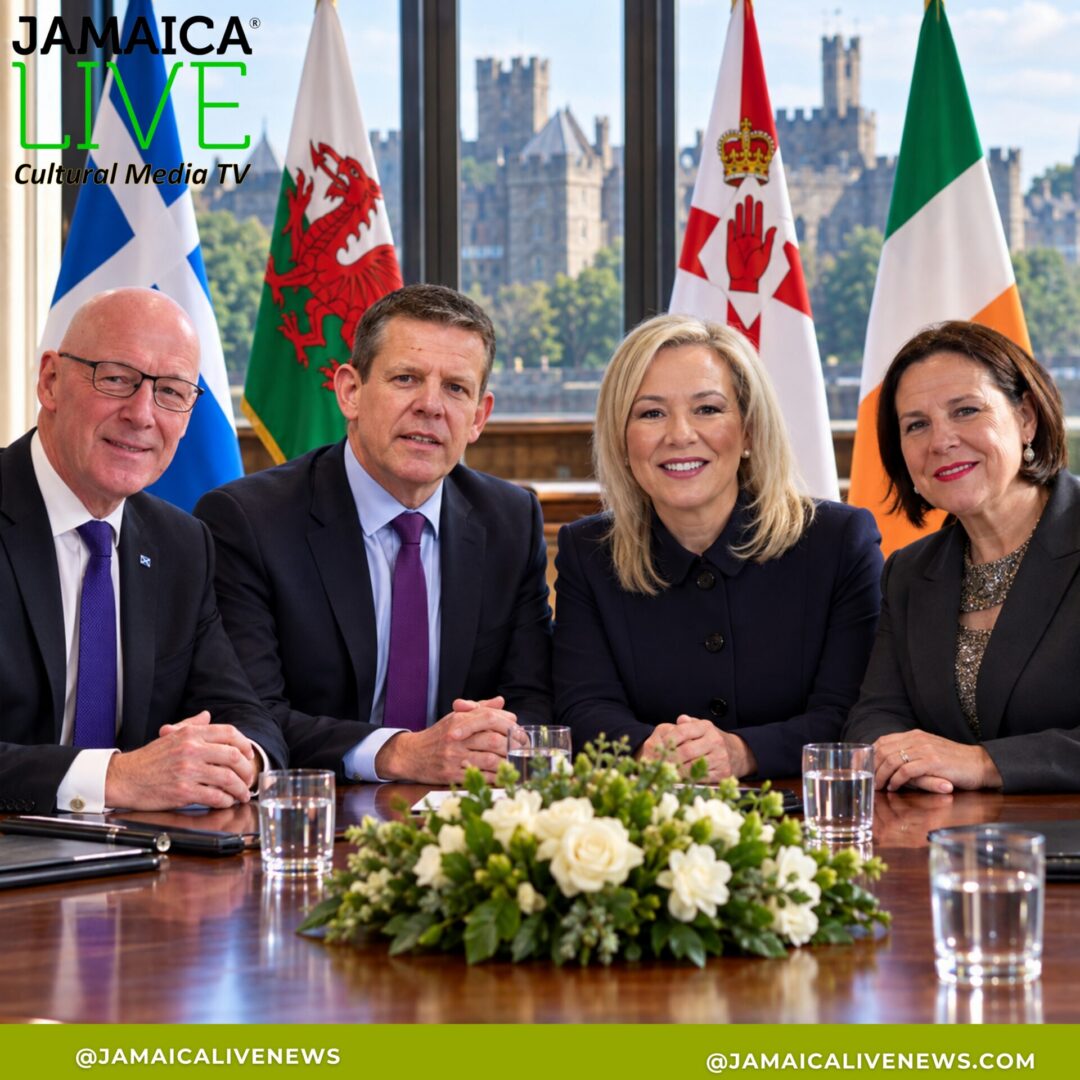
Rhun ap Iorwerth — First Minister of Wales and Leader of Plaid Cymru
Michelle O’Neill — First Minister of Northern Ireland and Vice-President of Sinn Féin
Mary Lou McDonald — President of Sinn Féin and Leader of the Opposition in Ireland
The three First Ministers are expected to attend in their capacities as leaders of their respective political parties, rather than formally representing their devolved governments. The planned memorandum of understanding is expected to affirm that the people of Scotland, Wales and Northern Ireland should ultimately have the ability to determine their own constitutional futures.
The significance of the Cardiff summit extends beyond the signing of a document. For the first time, all three of the UK’s devolved nations are headed by First Ministers from parties that support either independence or, in Northern Ireland’s case, Irish reunification. Ap Iorwerth became Wales’s First Minister in May following Plaid Cymru’s historic electoral victory.
More than independence on the agenda
While the constitutional future of the United Kingdom is expected to dominate attention, the leaders are also due to discuss broader cooperation between the three nations, including economic policy, energy and relations with Europe.
The summit does not, however, mean that Scotland, Wales or Northern Ireland will immediately leave the United Kingdom, nor does the declaration itself trigger independence referendums. Instead, it represents a coordinated political effort to increase pressure on Westminster over who should ultimately have the authority to call such votes.
The constitutional circumstances of the three nations are also different.
Scotland held an independence referendum in 2014, when voters chose to remain in the United Kingdom. The question of another referendum has remained a major political issue since then.
Northern Ireland operates under a separate constitutional framework stemming from the peace settlement and the principle of consent, with the possibility of a future referendum on whether Northern Ireland should remain part of the United Kingdom or become part of a united Ireland.
Wales, meanwhile, has not previously held an independence referendum, although Plaid Cymru has long advocated Welsh independence.
Pressure builds on Westminster
The Cardiff gathering comes during renewed debate over the structure and future of the United Kingdom under Prime Minister Andy Burnham.
Burnham became UK Prime Minister in July 2026. Following his appointment, Welsh First Minister Rhun ap Iorwerth called for a redefinition of relations between Cardiff and Westminster and greater powers for Wales.

The Cardiff summit comes amid a developing political clash between Scottish First Minister John Swinney and UK Prime Minister Andy Burnham over who should ultimately decide whether Scotland holds another independence referendum. Burnham told Parliament that a future vote could be considered if a “clear consensus” emerged among the Scottish public, prompting Swinney to formally request talks on creating an agreed legal mechanism for another referendum
However, Burnham subsequently stressed that no referendum is currently planned, maintaining that another independence vote remains “off limits” for now as his government focuses on economic growth, public services and the cost of living.
The constitutional debate intensified further following recent comments from U.S. President Donald Trump supporting the idea of a united Ireland. Downing Street subsequently said Burnham’s position had not changed and maintained that there was currently insufficient public support to justify another referendum on Irish unity.
The UK government has similarly resisted demands for another immediate Scottish independence referendum.
The Cardiff summit therefore places three nationalist movements around the same table at a politically significant moment, but substantial legal and political hurdles remain before any of the three nations could change its constitutional status.
Could the United Kingdom actually break apart?
The United Kingdom currently consists of England, Scotland, Wales and Northern Ireland. Any successful move by Scotland or Wales towards independence, or Northern Ireland towards reunification with the Republic of Ireland, would fundamentally reshape the political structure of the UK.
However, Monday’s declaration should not be confused with an agreement actually to dissolve the United Kingdom.
Rather, the leaders are seeking recognition of a principle: that their respective populations should have the ability to decide their constitutional futures through democratic referendums.
That distinction is important. The Cardiff meeting may represent an unusually coordinated challenge to Westminster’s authority over constitutional referendums, but the ultimate decisions would require considerably more political, legal and public support.
What makes Monday’s meeting particularly noteworthy is that the independence movements of Scotland, Wales and Northern Ireland will no longer be speaking entirely separately. Their leaders are preparing to present a coordinated position on self-determination while exploring closer cooperation in other areas.
Whether that develops into a lasting political alliance — or ultimately contributes to a fundamental restructuring of the United Kingdom — remains to be seen.
For now, the Cardiff summit represents another significant chapter in the long-running debate over who should ultimately decide the future of the United Kingdom: Westminster, or the individual nations that make up the Union.