

Former PNP Senator Andre Haughton Reportedly Gave Character Reference for Chronic Law Amid U.S. Federal Gun Case
Jamaica Live News Desk– | Sept 17, 2026
KINGSTON, Jamaica —A potentially significant development has emerged in the U.S. federal case involving Jamaican dancehall artiste Chronic Law, whose given name is Ackeme Jermane Campbell, with Nationwide News reporting that Professor Andre Haughton — a former Opposition Senator and prominent member of the People’s National Party — provided a character reference on the entertainer’s behalf.
A character-reference letter bearing the letterhead of The University of the West Indies, Mona Campus, Department of Economics, and identifying its author as Professor Andre Haughton, has surfaced in connection with dancehall artiste Chronic Law, whose given name is Ackeme Jermane Campbell.

The Charges: The 32-year-old artist is charged with possession of a firearm by a prohibited person (or an alien in possession of a firearm).
Bail Status: He was previously denied bail after prosecutors argued that he poses a significant flight risk. He remains in the custody of the U.S. Marshals Service.
The January 20, 2026 letter, addressed to an “Honorable Immigration Judge,” was shared by Nationwide News and was written while Campbell was in United States immigration custody.
In the document, Haughton states that he was writing in his capacity as “a Professor at the University of the West Indies, Member of Parliament Caretaker for the St James West Central Constituency and Former Senator in the Jamaican Government” to provide a character reference for Campbell.
Haughton is currently listed by The UWI as a Professor in its Department of Economics at the Mona Campus. The university announced his appointment as Professor of Applied Macroeconomics, effective October 8, 2025.
Music Artist on O-1B Visa Charged with Illegally Possessing Firearms, Stolen Gun, 92 Rounds of Ammunition
According to the U.S. Attorney’s Office, Middle District of Georgia, U.S. federal prosecutors have charged Jamaican dancehall artiste Ackeme Jermane Campbell, known professionally as Chronic Law, with possession of a firearm by a prohibited person. According to the criminal complaint, Campbell, who was residing and performing in the United States on an O-1B visa, allegedly fled deputies in Turner County, Georgia, at speeds exceeding 120 mph on November 15, 2025. Authorities say officers subsequently recovered four firearms, including a gun reported stolen from Miami, and 92 rounds of ammunition. Prosecutors allege Campbell admitted the firearms belonged to him and that he had not obtained the required waiver permitting him to possess them. The U.S. government also alleged Campbell had an affiliation with a criminal gang and presented him as a flight risk, factors cited in his detention without bond. Campbell was arrested in Miami on July 5, 2026, and remains in federal custody. He faces up to 15 years in prison, three years of supervised release and a US$250,000 fine if convicted. The charges are allegations, and Campbell is presumed innocent unless proven guilty.
Haughton described Chronic Law as disciplined and respectful of authority
In his character reference, Haughton described Campbell as a widely recognised cultural figure whose music had resonated with young Jamaicans at home and throughout the diaspora.
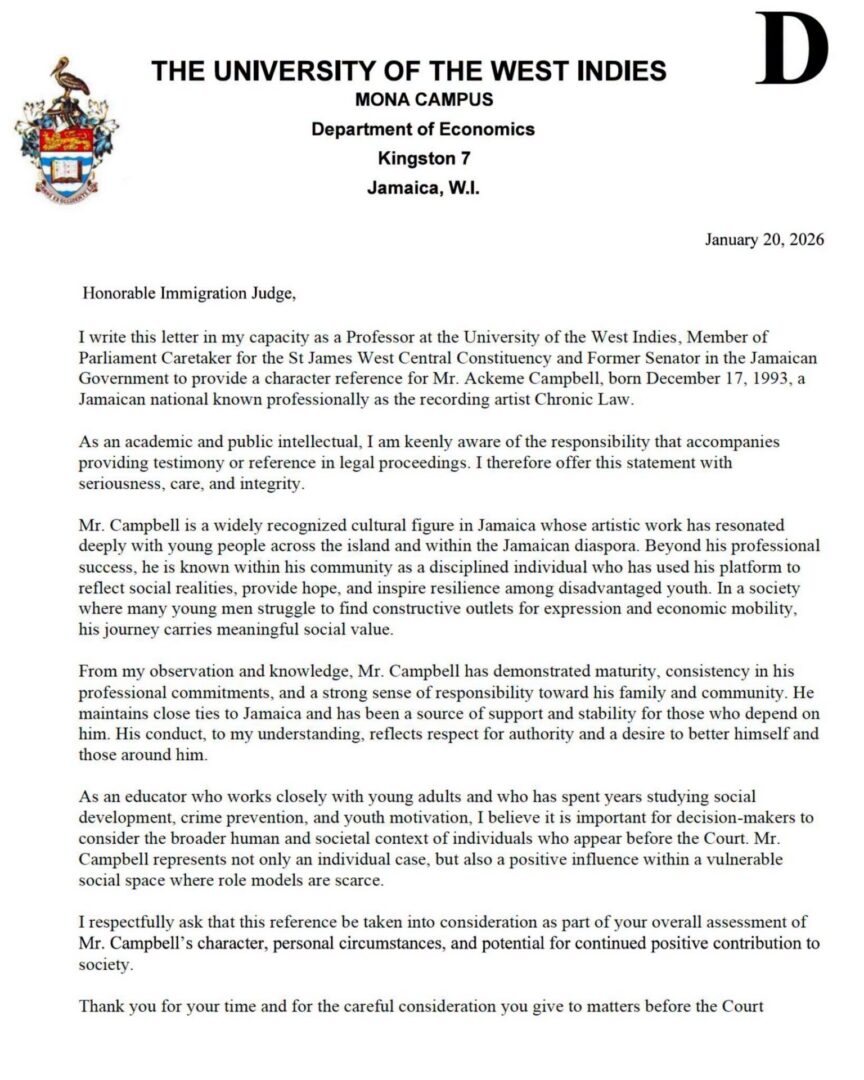
He wrote that Campbell was known within his community as a “disciplined individual” who had used his platform to provide hope and inspire disadvantaged young people.
Haughton further stated that, based on his observation and knowledge, Campbell had demonstrated maturity and responsibility toward his family and community.
One of the more notable portions of the letter states that Campbell’s conduct, “to my understanding, reflects respect for authority and a desire to better himself and those around him.”
Haughton ultimately asked the immigration judge to take the reference into consideration when assessing Campbell’s character, personal circumstances and potential contribution to society.
Letter came days after Chronic Law entered ICE custody
The timing of the letter is significant.
Campbell was detained by U.S. Immigration and Customs Enforcement on January 12, 2026, eight days before Haughton’s letter was dated. At the time, U.S. immigration officials publicly provided few details regarding the reason for his detention. Nationwide reported on January 16 that Campbell was being held at the Florida Soft Side South detention centre.
Nationwide has since reported, citing court documents, that Campbell’s O-1B visa had been revoked on January 2 following his November 2025 arrest in Turner County, Georgia. The immigration proceeding against him was later terminated on March 18 after an immigration judge determined that he was not removable under the circumstances surrounding the visa revocation.
The January character reference therefore relates to Campbell’s immigration proceedings, not directly to the federal firearm prosecution that was subsequently brought against him.

A federal criminal complaint charging Campbell with possession of a firearm by a prohibited person was filed on July 1, 2026 and unsealed later that month. He was arrested in Miami on July 5 and detained without bond.
The U.S. Department of Justice has stressed that the complaint contains allegations only and that Campbell is presumed innocent unless proven guilty in court.
Questions over UWI letterhead and political credentials
The publication of Haughton’s January letter introduces a separate set of public-interest questions.
The document does not merely identify Haughton personally. It prominently carries UWI Mona Campus Department of Economics letterhead, while Haughton expressly identifies himself by his university position as well as his former Senate and constituency-caretaker roles.
The document itself does not establish whether The University of the West Indies authorised or was aware of the use of its letterhead for the character reference. Jamaica Live has also not established whether Haughton was acting with the knowledge or approval of the PNP when referring to his political credentials.
Those distinctions are important. A character reference may be submitted in an individual’s personal capacity, while the use of professional or political titles does not by itself establish that the institutions associated with those titles endorsed the contents of the letter.

The matter is likely to attract significant public attention because Haughton is not only a senior UWI academic but also a former Opposition Senator and PNP political candidate. It comes at a time when crime, policing and fatal encounters involving the security forces are at the centre of national debate. As of September 14, 2026, the Independent Commission of Investigations (INDECOM) reported 67 deaths arising from 26 incidents in which security-force operations resulted in multiple fatalities.
The PNP has been among those raising concerns about police use of force, making Haughton’s decision to provide a favourable character reference for Campbell particularly relevant to the wider public discussion. However, Haughton’s actions should not automatically be treated as representing the PNP’s position. It remains to be established whether he wrote the letter entirely on his own behalf or whether the PNP had any knowledge of or involvement in the reference.
For now, the document establishes that Haughton invoked both his UWI professorship and his political background while asking a U.S. immigration judge to consider a favourable character assessment of Campbell.
The outstanding questions are whether UWI authorised the use of its letterhead, whether the PNP had any knowledge of the reference, and what Haughton knew about Campbell’s November 2025 encounter with U.S. law enforcement when he wrote the letter on January 20.