

Oxtail vs Kangaroo Tail: What’s the Difference and Can You Tell Them Apart?
Jamaica Live News Desk– | Sept 4, 2026
Jamaica Live News — Food & Culture
Oxtail is one of Jamaica’s most celebrated dishes, but a viral comparison between oxtail and kangaroo tail has sparked an unusual conversation online, with people examining the similarities between the two cuts of meat and asking: Could you tell the difference?
Images circulating on social media show sliced kangaroo tail alongside beef oxtail. To the untrained eye, the cuts can appear surprisingly similar, particularly because both contain bone surrounded by meat and connective tissue.
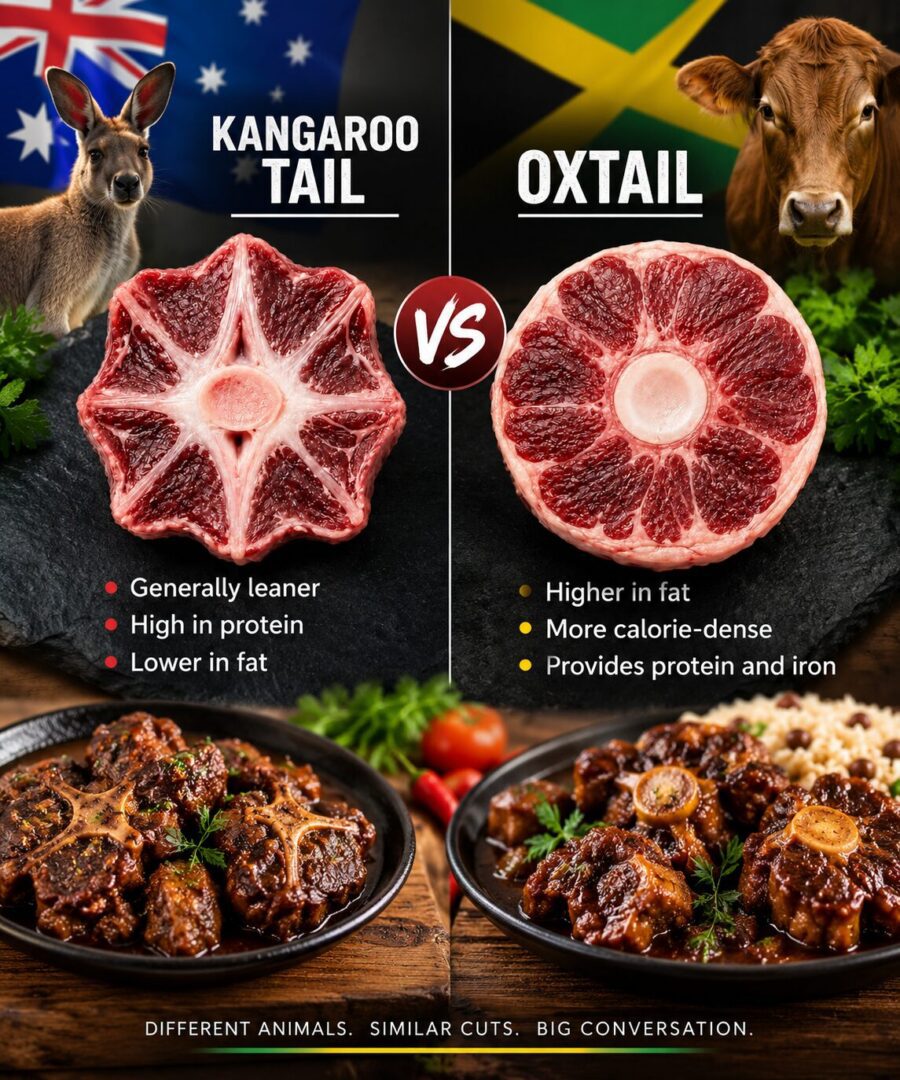
But despite their appearance, they are, of course, meats from two entirely different animals.
What exactly is oxtail?
Traditionally, the term “oxtail” referred to the tail of an ox. Today, however, oxtail sold commercially generally refers to the tail of cattle, regardless of whether the animal was specifically an ox.
The tail is cut crosswise into sections, producing the distinctive round pieces with bone in the centre that Jamaicans immediately recognise.
Because oxtail contains significant amounts of connective tissue, it benefits from long, slow cooking. That process helps create the rich, gelatinous gravy associated with the dish.
In Jamaica, brown-stewed oxtail — often served with rice and peas, butter beans and vegetables — has become an internationally recognised part of Jamaican cuisine.
So what about kangaroo tail?
Kangaroo meat is commercially consumed in Australia and exported to some international markets. Kangaroo tail can also be cut into sections and slow-cooked, which helps explain why photographs of the raw cuts have generated so much attention.
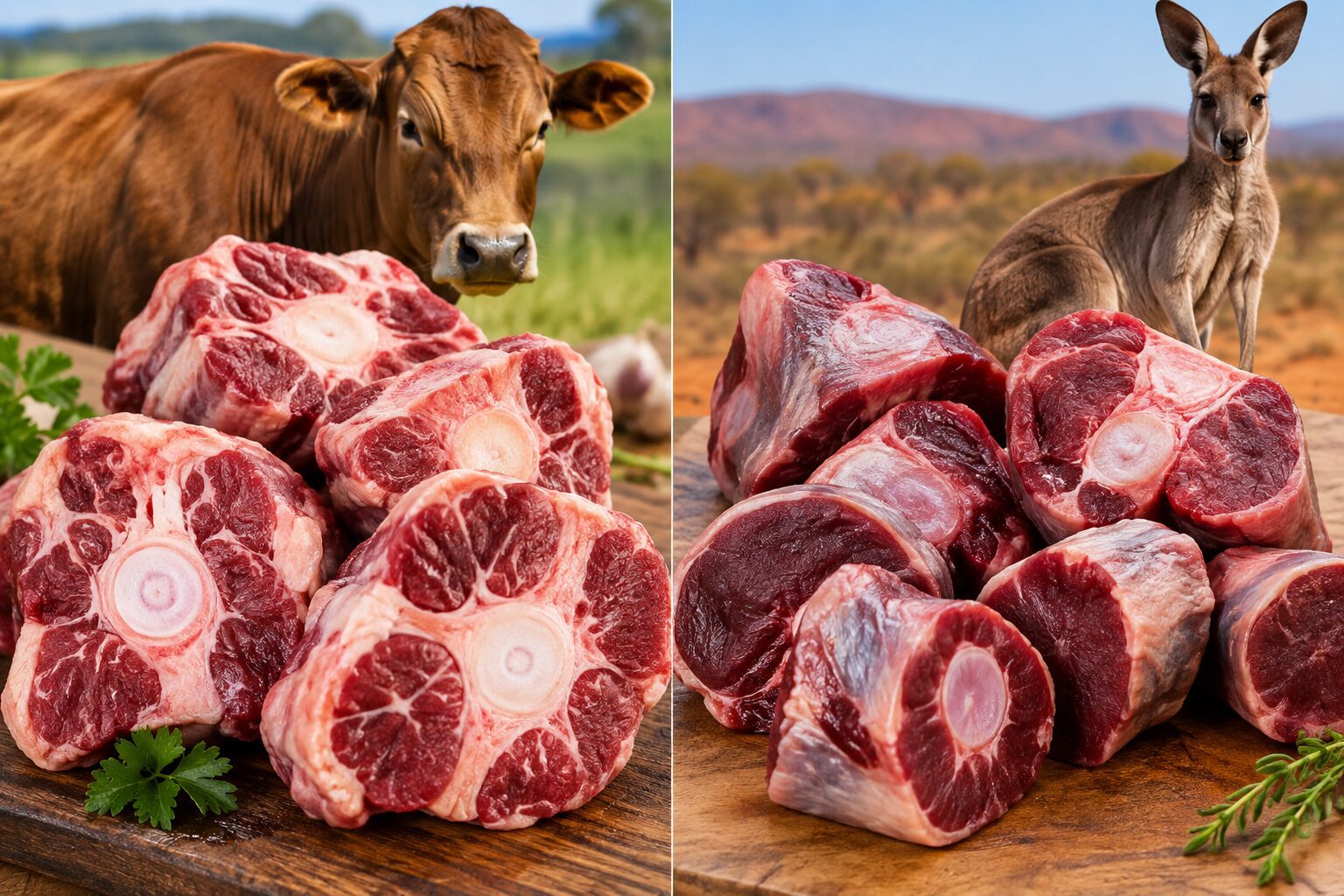
Nutritionally, however, there can be differences. Kangaroo meat is generally regarded as relatively lean and high in protein, while oxtail can be considerably richer in fat depending on how it is trimmed and prepared.
That does not mean kangaroo tail is secretly being sold as oxtail in Jamaica. A visual resemblance is not evidence of substitution or food fraud, and claims that one meat is being passed off as another would require evidence such as supply-chain records or laboratory testing.
Where does Jamaica’s beef come from?
Jamaica produces cattle domestically but also relies on imported beef and bovine products.
Trade statistics for the broader category of frozen edible bovine offal show that Jamaica has imported products from countries including Ireland, the United States, Australia, New Zealand, Panama and Costa Rica, among others.
However, international trade statistics do not always isolate retail “oxtail” neatly from broader beef and bovine-product categories. It would therefore be misleading to use those figures alone to claim that Jamaica’s oxtail comes predominantly from any particular country.
Could you tell the difference?
For Jamaicans, the viral comparison has become particularly fascinating because oxtail isn’t just another cut of beef — it is part of the country’s culinary identity.
And with oxtail commanding premium prices in many restaurants and supermarkets, consumers understandably want to know exactly what they are buying.
So while there is currently no basis from the viral photographs alone to conclude that kangaroo tail is being passed off as oxtail in Jamaica, the comparison has certainly accomplished one thing:
People are checking their plates. 👀
Oxtail or kangaroo tail — could YOU tell the difference?
Kangaroo Tail vs Oxtail: The Differences Go Beyond Appearance
Although kangaroo tail and beef oxtail can look surprisingly similar when cut into sections, the two meats have significantly different nutritional profiles, fat content, anatomy and cooking characteristics.
Kangaroo is an exceptionally lean red meat. General lean cuts are commonly reported at roughly 100–116 calories per 100 grams, with approximately 23–30 grams of protein and less than 2.6 grams of fat. Beef oxtail, by comparison, is a considerably richer cut. Depending on trimming and the specific nutritional database used, raw oxtail can contain roughly 240–260 calories per 100 grams, around 18–20 grams of protein and approximately 16–22 grams of fat. Exact figures vary according to the cut, trimming and preparation method.
The difference is also structural. Kangaroos are highly active animals, and their meat is characteristically dark, dense and extremely lean. The powerful tail plays an important role in balance and locomotion and contains substantial muscular tissue. Beef oxtail, meanwhile, contains considerable connective tissue, collagen and fat, characteristics that make it particularly well suited to long, slow cooking.
That difference becomes especially noticeable in the pot. As oxtail slowly braises, its collagen breaks down into gelatin while its fat renders into the cooking liquid, helping produce the rich, silky texture and thick, glossy gravy associated with a traditional Jamaican oxtail dish. Kangaroo meat contains far less fat and therefore generally requires careful slow cooking and sufficient moisture to prevent the meat from becoming dry or tough.
Can You Tell Them Apart?
The viral debate has also prompted people to ask whether they could distinguish raw kangaroo tail from genuine beef oxtail simply by looking at it.
There can be visible differences in bone structure, the amount of surrounding fat, the colour and density of the meat, and the dimensions of individual cuts. Beef oxtail commonly has a noticeable layer of white fat surrounding portions of the meat and can display substantial connective tissue. Kangaroo meat is generally much leaner, darker and has considerably less visible external fat.
However, consumers should be cautious about relying on viral photographs or a supposed single “star-shaped versus round bone” rule to identify an unknown piece of meat. Vertebrae change shape along the length of an animal’s tail, and appearance also depends on exactly where and how the tail was cut. Visual inspection alone is therefore not a foolproof method of identifying the species.
Once cooked, differences may also emerge in texture and flavour. Traditional slow-cooked beef oxtail develops its characteristic gelatinous richness and tender texture because of its collagen and fat content. Kangaroo is substantially leaner and is generally associated with a firmer texture and a more distinctive game-like flavour.
For Jamaican consumers, the discussion is particularly interesting because oxtail occupies an important place in Jamaican food culture and commands premium prices in restaurants and supermarkets. But similarities between photographs of the two meats should not automatically be interpreted as evidence that kangaroo is being sold as oxtail.
The viral comparison is useful for educating consumers, but proving that one species has been substituted for another would require more than appearance — traceable sourcing, accurate labelling and, where necessary, laboratory species testing would provide far stronger evidence.
© Jamaica Live News | JamaicaLiveNews.com