

Woman Gives Birth Mid-Flight from Jamaica to US, Ignites Birthright Citizenship Debate
Jamaica Live News Desk– | April 11, 2026
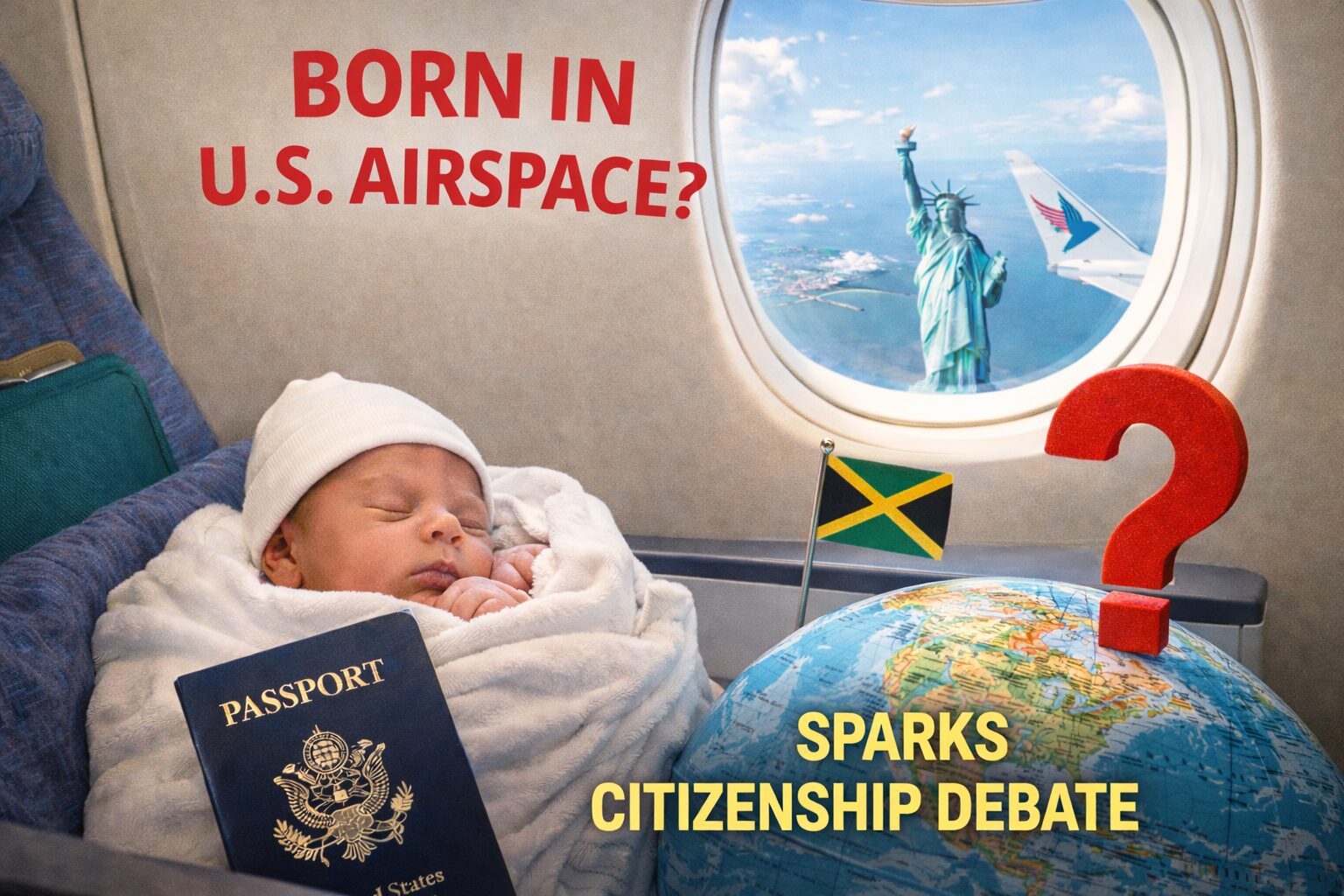
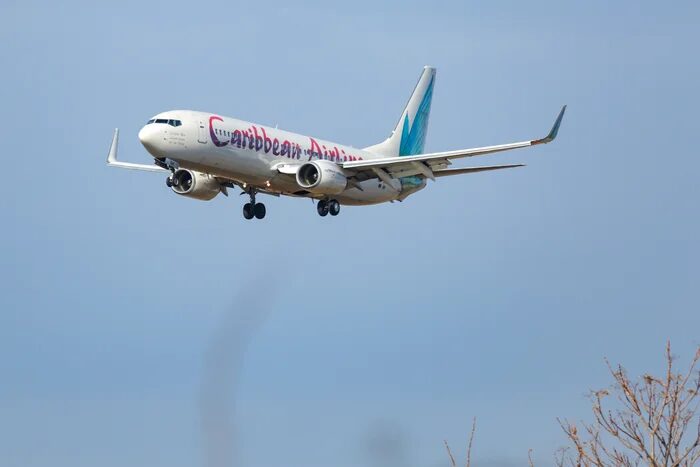
A routine flight from Kingston to New York turned into a global talking point after a baby was born mid-air aboard Caribbean Airlines Flight BW005 on April 4, 2026 — raising a complicated and controversial question: Where does this child legally belong?
Passengers onboard the flight, which was approaching John F. Kennedy International Airport, witnessed the dramatic moment as the mother went into labour at 30,000 feet. The airline later confirmed that crew members handled the situation with professionalism, ensuring both mother and baby landed safely in New York, where medical teams were waiting.
But while the delivery was smooth, what followed has been anything but.
A Birth Without Borders — Or A Legal Headache?
The child’s citizenship status is now under scrutiny, with legal experts pointing out that everything depends on one key detail: exactly where the plane was when the baby was born.
Under U.S. law, if the birth occurred within American airspace — defined as roughly 12 miles from the U.S. coastline — the child could automatically be granted U.S. citizenship. But proving that exact moment is no easy task.
New York-based immigration attorney Cyrus D. Mehta weighed in on the issue, warning that births outside traditional hospital settings can quickly become legal puzzles.
“Sometimes, when a child is not born in a hospital and there’s no birth record, that can create problems,” Mehta explained.
Without precise documentation of the aircraft’s position at the exact second of birth, the child’s legal identity could fall into a grey zone — not fully Jamaican, not clearly American, and potentially caught in bureaucratic limbo.
‘Name the Baby Kennedy’ — A Light Moment in a Heavy Debate
In the middle of the chaos, one moment of humour cut through.
Air traffic control audio captured a controller jokingly telling the pilot:
“Tell her she’s got to name it Kennedy.”
The pilot laughed and replied, “Kennedy, will do.”
A lighthearted exchange — but one that now sits in stark contrast to the serious legal storm brewing around the newborn’s future.
Citizenship: Simple Law, Complicated Reality
On paper, the rules seem straightforward:
- If either parent is a U.S. citizen — the child is automatically American.
- If the birth happened in U.S. airspace — citizenship could apply.
- If neither condition is met — things get murky.
And that’s where this case is now sitting — in uncertainty.
Because unlike births on land, there’s no hospital timestamp, no official delivery room, and no immediate government record confirming where the child entered the world.
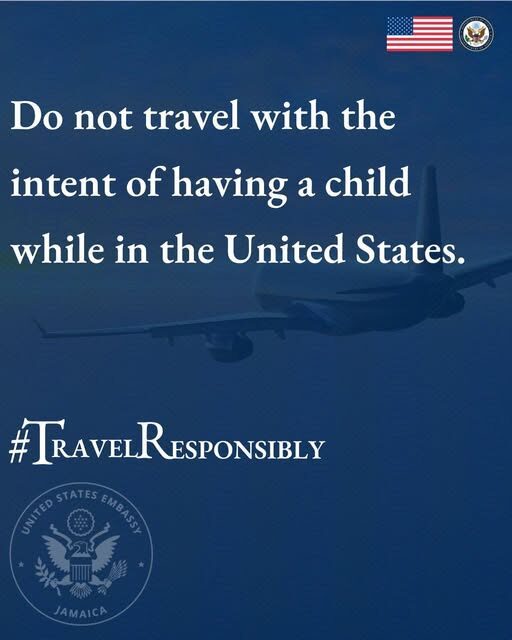
So far, there is no confirmed information about the mother’s nationality — whether she is Jamaican, American, or holds dual status. Yet online speculation has already taken a sharp turn, with some suggesting the possibility of “birth tourism” — a controversial practice where individuals travel to the United States with the intent of securing citizenship for their child.
The U.S. Embassy in Jamaica has long warned that such intentions can lead to serious consequences, including visa denial or revocation if consular officers suspect the primary purpose of travel is to give birth on U.S. soil. Authorities have also cautioned that relying on public assistance, such as Medicaid, during such births can jeopardize future immigration eligibility.
Adding even more weight to the debate, the Executive Order 14160 — introduced by Donald Trump — is now under scrutiny before the U.S. Supreme Court, challenging the long-standing interpretation of the 14th Amendment, which guarantees citizenship to all persons born on U.S. soil. The outcome of that case could redefine the very principle now being debated in this mid-air birth.
Caribbean Airlines confirmed that its policy allows pregnant passengers to travel without medical clearance up to 32 weeks — meaning the mother was within permitted guidelines.
Still, the incident is raising broader questions:
- Should airlines tighten restrictions on late-stage pregnancies?
- Who bears responsibility when births happen mid-flight?
- And most critically — should a child’s nationality depend on geography measured in miles… mid-air?
For now, the newborn — whether “Kennedy” or not — remains at the centre of a legal and political conversation that stretches far beyond a single flight.
What should have been a joyful moment has turned into a symbol of a much bigger issue: how modern borders struggle to keep up with real life.
Because when a child is born in the sky — between countries, between laws — the question becomes uncomfortable but unavoidable: Who gets to claim them?