

Crime Against Humanity—But No Accountability? U.S., Israel and Argentina Vote ‘No’ as World Confronts Slavery’s Legacy”
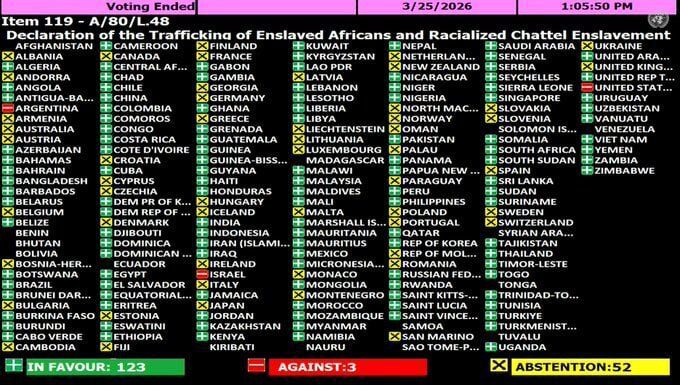
On March 25, 2026, the United Nations General Assembly passed a historic resolution—A/80/L.48—formally declaring the transatlantic trafficking and racialized enslavement of Africans as “the gravest crime against humanity.” Backed by 123 nations and championed by Ghana under the leadership of John Dramani Mahama, the resolution pushes the world closer to an uncomfortable but long-overdue conversation: reparations, restitution, and historical accountability.
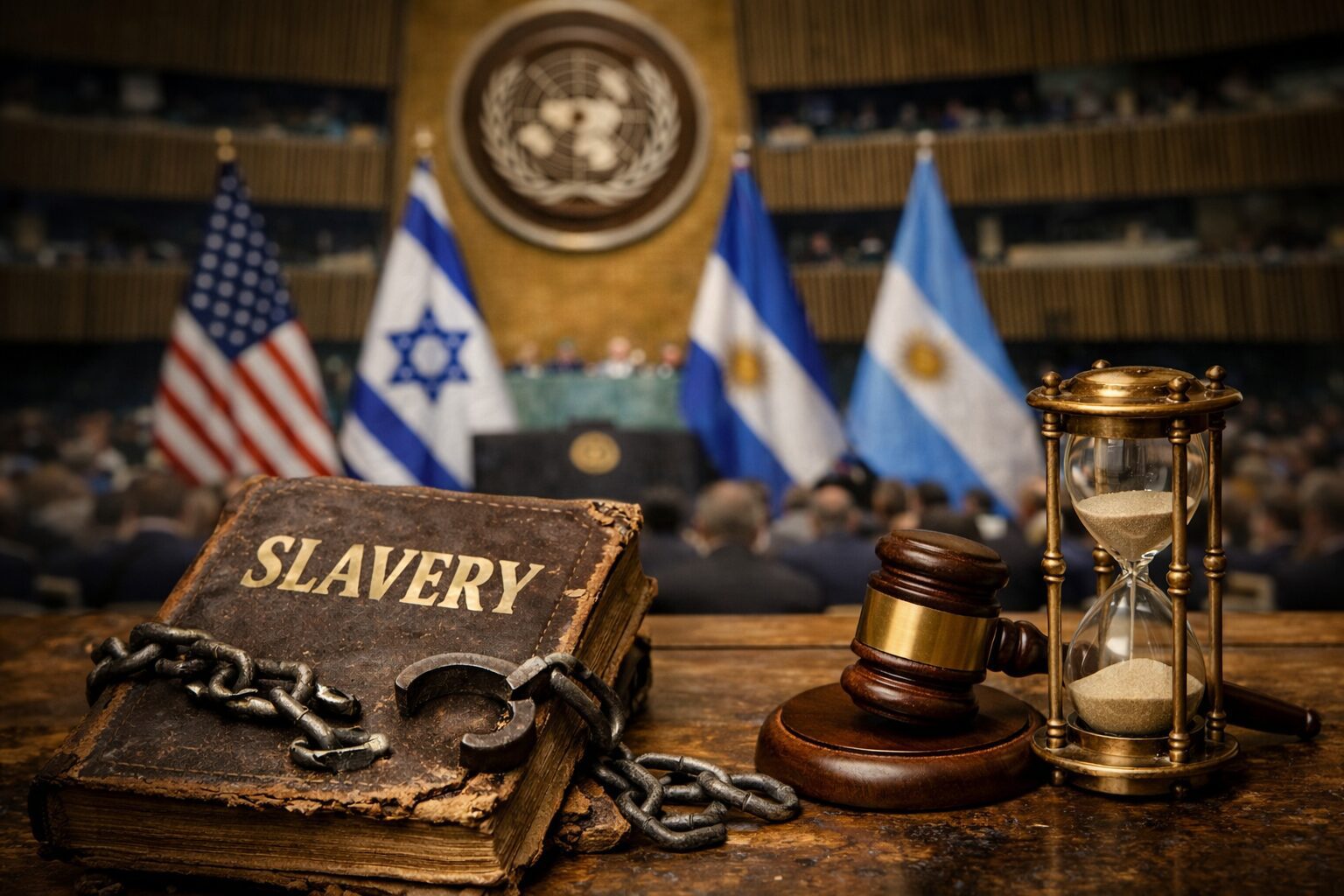
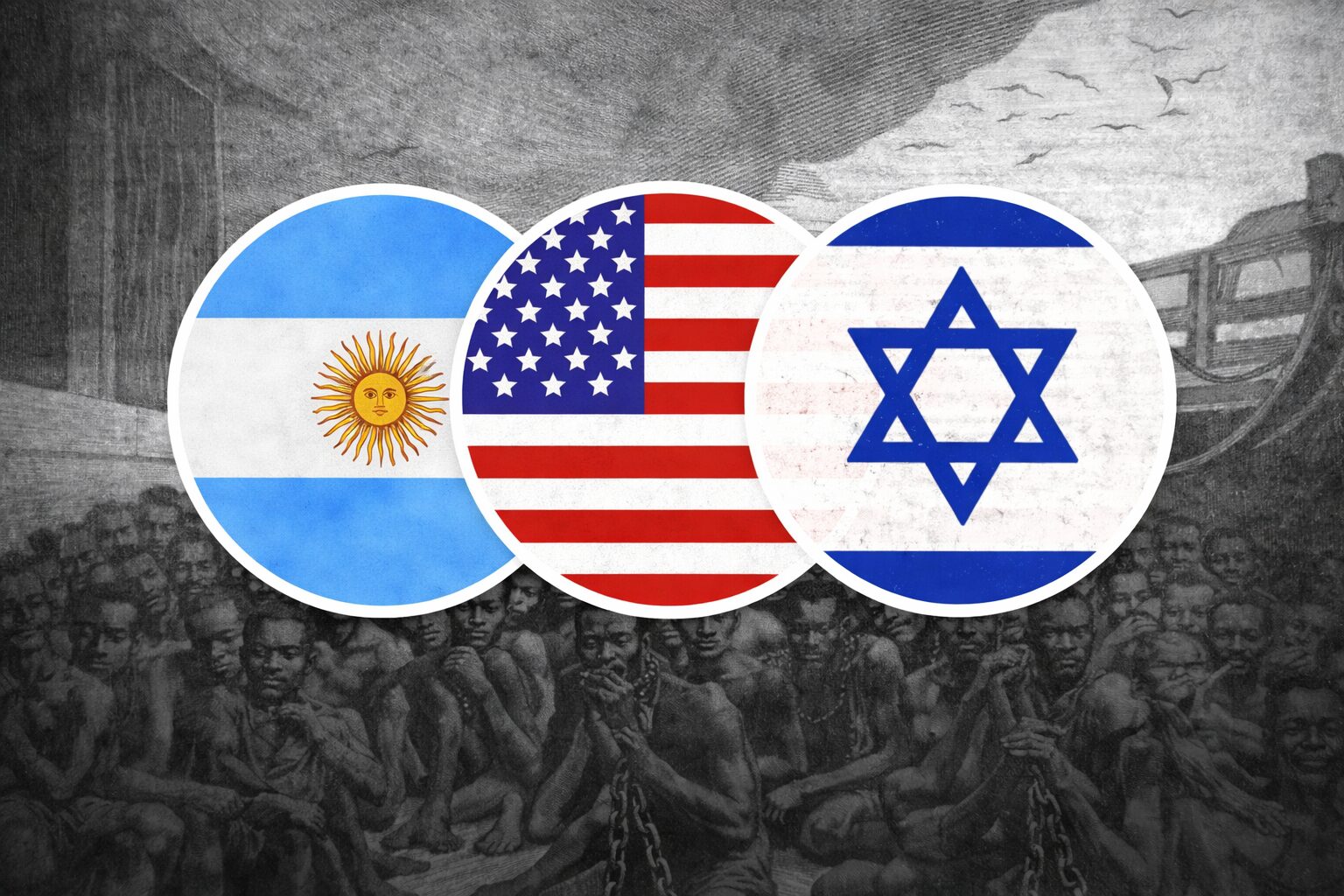
But while much of the world moved forward, three countries stood apart—voting against the resolution: the United States, Israel, and Argentina.
That “no” vote is not just a diplomatic footnote. It is a statement.
The Real Fear: Reparations, Not Recognition
Officially, the justification from opposing and abstaining nations centers on legal language. Labeling slavery as the “gravest crime against humanity” raises a dangerous possibility—for them. It strengthens the moral and political argument for reparations.
Let’s be blunt:
This is not about history. This is about money, power, and liability.
If slavery is formally recognized at the highest level as one of humanity’s greatest crimes, then the question becomes unavoidable—who pays for it?
The United States: Built on Slavery, Resistant to Accountability
The United States—arguably the most prominent beneficiary of the transatlantic slave trade—voted against the resolution.
This is a country whose economic foundation was built on enslaved African labor. Cotton, tobacco, infrastructure, banking systems—all tied to centuries of exploitation. Even after abolition, systems like Jim Crow, redlining, and mass incarceration extended that legacy into the modern era.
Yet, when faced with a global call to acknowledge that history as the gravest crime against humanity, Washington said no. The reason is not difficult to understand—acknowledgment is never neutral. Once a crime is fully recognized, it inevitably leads to demands, and those demands lead to accountability. And accountability, especially on a scale this large, comes with a cost that many powerful nations have long shown they are unwilling to pay.
Argentina: A Complicated Past, A Predictable Vote
Argentina’s “no” vote raises its own questions.
Often seen as a European-leaning outlier in Latin America, Argentina has long tried to distance itself from its own erased Afro-descendant history. Once home to a significant Black population during the colonial period, that history was gradually erased through war, disease, and deliberate national narratives that emphasized European identity.
At the same time, Argentina with the largest Jewish community in Latin America and the sixth-largest in the world maintains strong diplomatic alignment with both the United States and Israel. Its vote cannot be viewed in isolation—it reflects geopolitical loyalty.
Argentina’s vote also reflects its current political reality—one defined by deep alignment with Washington and Tel Aviv. In recent years, Buenos Aires has leaned heavily on the United States for financial lifelines amid ongoing economic instability, with bailout support and international backing playing a critical role in keeping its economy afloat. That dependency does not come without influence. At the same time, Argentina has strengthened its diplomatic and ideological ties with Israel, positioning itself firmly within a U.S.-aligned bloc on the global stage. In that context, its vote against the resolution looks less like an isolated decision and more like a continuation of a broader geopolitical alignment—where loyalty to powerful allies often outweighs moral positioning on historical justice.
Israel: Strategic Alignment and Political Calculations
Israel’s opposition aligns closely with the United States on many global issues, particularly within multilateral institutions like the UN.
While Israel’s own history is deeply tied to persecution and genocide of the Palestinians, its foreign policy decisions often prioritize strategic alliances over symbolic global resolutions—especially those that could open doors to legal or financial precedents. In this case, standing with Washington was not surprising.
It was expected.
Many of the countries resisting or hesitating—including Western powers that abstained like the United Kingdom, France, and Germany—are nations that directly benefited from the slave trade.
These are countries that:
- Built wealth through forced labor
- Expanded empires on the backs of enslaved Africans
- Continue to benefit from global inequalities rooted in that history
Yet when the moment comes to formally acknowledge that crime—and potentially repair it—they hesitate, abstain, or outright reject it.
So the question becomes unavoidable:
Is this about legal nuance… or moral evasion?
A Global Shift—With Resistance
Despite the opposition, the resolution marks a turning point.
For decades, conversations around slavery were framed as history—closed, distant, resolved.
This resolution rejects that idea.
It declares that slavery is not just past—it is present in its consequences:
- Economic inequality
- Racial hierarchies
- Global power imbalances
And it demands not just remembrance, but repair.
In the end, the numbers speak louder than any diplomatic statement—123 countries stood up and declared slavery the gravest crime against humanity, while just three said no. That divide tells its own story. When the world inches toward justice, it is often those who benefited most from injustice who push back the hardest. The debate is no longer about whether slavery was a crime—the global community has already answered that. What remains unresolved is far more uncomfortable: who is prepared to take responsibility for it, and who is still running from the bill.