

Golding at the Crossroads: Age, Ancestry, and the Battle for Jamaica’s Future
Jamaica Live News Desk– | Mar 20, 2026
Golding’s Early Power Play Raises Questions of Timing, Identity and Readiness
Opposition Leader Mark Golding has made a bold declaration—he intends to lead the People’s National Party (PNP) into the next general election and is confident of defeating Prime Minister Andrew Holness. But with Jamaica not constitutionally due for an election for several years, the statement lands less as a campaign launch and more as a calculated political move.
At this stage, Golding is not speaking to voters as much as he is speaking to his own party. His insistence that he retains full confidence and does not expect a leadership challenge appears designed to shut down internal dissent before it gains traction. In a party still rebuilding after electoral defeat, projecting stability is critical—but so is proving electability, something the PNP has yet to fully demonstrate.
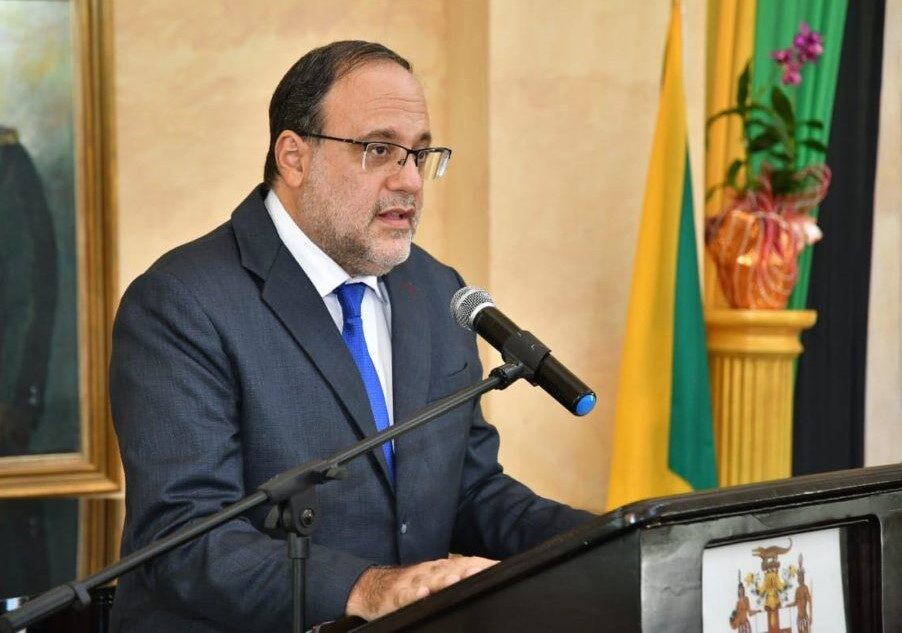
The party’s improvement in the 2025 general election—from 14 seats to 28—was significant, but it was not enough. The Jamaica Labour Party (JLP), under Andrew Holness, maintained government with 35 seats. That reality complicates Golding’s confident tone. Momentum alone does not win power, and with years to go before the next election, sustaining that momentum will be far more difficult than achieving it.
Golding’s leadership will now be tested not in a campaign season, but in the long stretch between elections where public attention shifts, crises emerge, and political narratives are reshaped. Declaring victory early raises expectations, but it also exposes him to prolonged scrutiny. Voters will be watching to see whether he can offer a compelling alternative to an administration that, despite criticism, has presided over measurable economic stability and reductions in major crime.
Beyond performance, Golding’s candidacy also continues to stir deeper questions about identity and representation. Jamaica remains a predominantly Black nation still grappling with the legacy of colonialism while moving toward republican status. Against that backdrop, Golding’s European ancestry and reported historical links to slave-owning lineage have become part of the political conversation. Jamaica is a proudly Black nation, born from resistance, survival, and cultural dominance over colonial rule. That makes Mark Golding’s background—of European descent, with ancestral ties to slave ownership—an unavoidable and deeply emotional topic.
Let’s be clear:
This is not about race alone. It is about historical symbolism.
As Jamaica moves toward becoming a Republic, removing the British monarch as Head of State, many Jamaicans are asking:
- What does it mean to replace colonial structures while elevating leadership tied to that very history?
- Can a man with such ancestry truly embody the psychological break from colonialism?
At the same time, others argue that modern Jamaica must move beyond bloodlines and judge leaders based on values, actions, and vision—not ancestry.
This is a national tension that cannot—and should not—be ignored.
These questions are unlikely to disappear. If anything, they will intensify as Jamaica advances discussions about removing the British monarch as head of state. The optics of leadership—who represents the nation and what that representation signals—will matter alongside policy and competence.
AGE & LEADERSHIP: DOES 65 MATTER?
By the time the next general election arrives, Opposition Leader Mark Golding will be 65 years old. In many parts of the world, that is considered seasoned leadership. In others, it raises concerns about energy, longevity, and adaptability in a rapidly changing political landscape.
Jamaica must ask itself honestly:
Do we want experience at the helm—or a generational shift? Age alone does not determine competence. But in a country battling crime, economic transformation, digital evolution, and youth disengagement, leadership must not only be wise—it must be dynamic.
There is also the issue of continuity. If the current administration continues to deliver relative economic stability and improved security outcomes, Golding must clearly articulate what a PNP government would do differently. Without that distinction, the electorate may see little reason to replace one leadership with another offering similar outcomes. Elections are not won on dissatisfaction alone—they are won on credible alternatives.
The Andrew Holness-led administration has, by many measures:
- Reduced major crime rates
- Strengthened macroeconomic stability
- Maintained investor confidence
- Navigated global shocks with relative resilience
So the question becomes unavoidable:
👉 Can the PNP outperform what already exists—or are they simply promising to manage it?
Golding has yet to fully convince large sections of the electorate that his policies represent a clear upgrade rather than a political alternative. Ironically, one of Golding’s biggest challenges may be this:
If Jamaica is stabilizing economically and seeing reductions in crime, why risk changing leadership?
And if the PNP intends to continue similar economic policies, then voters must ask:
👉 What exactly is the difference?
Is this election about change, or just change of faces?
Speaking to Radio Jamaica on March 19, Golding said “We didn’t quite make it in September. There are reasons why that didn’t happen in a few seats, but we doubled the number of seats that we had before. We got 100,000 more votes than we got the previous time,” noted the PNP president.
Mr. Golding said he has the confidence of members of the People’s National Party to continue his leadership.
“As long as God is on my side and I have life and blowing breath, yes, I feel that I have a role to play, I feel I have the capacity to do it, and the party is behind me, and the people I think have shown that they have confidence in what we can deliver,” he maintained, insisting he did not anticipate a challenge from members of his party.
“If there was a vacancy, then…people might put their hat in the ring, but there’s no vacancy. And I don’t anticipate anybody’s going to challenge me if I am in the chair,” said Mr. Golding, who was speaking Wednesday night on TVJ’s All Angles.
Golding’s early declaration, therefore, is both a show of confidence and a political gamble. It positions him firmly as the PNP’s standard-bearer, but it also starts the clock on proving he can convert internal support into national trust. Jamaican voters are not being asked to decide today, but they are being given time—years, in fact—to evaluate whether his leadership matches his ambition.
In the end, the question is not whether Mark Golding believes he can win. It is whether, over time, he can convince Jamaica that he should.