

Jamaica’s Parliament Descends into Chaos: Has Mark Golding’s PNP Demonstrated It Is Unfit to Govern?
Jamaica Live News Desk– | Nov 07, 2026
Jamaica Live | Political Commentary & Analysis
The People’s National Party has demonstrated a disgraceful lack of discipline, sound judgement and respect for the dignity of Jamaica’s Parliament. The events of November 3, 2026, raise serious questions about the party’s political leadership, its ability to maintain order among its elected representatives and its fitness to govern Jamaica.
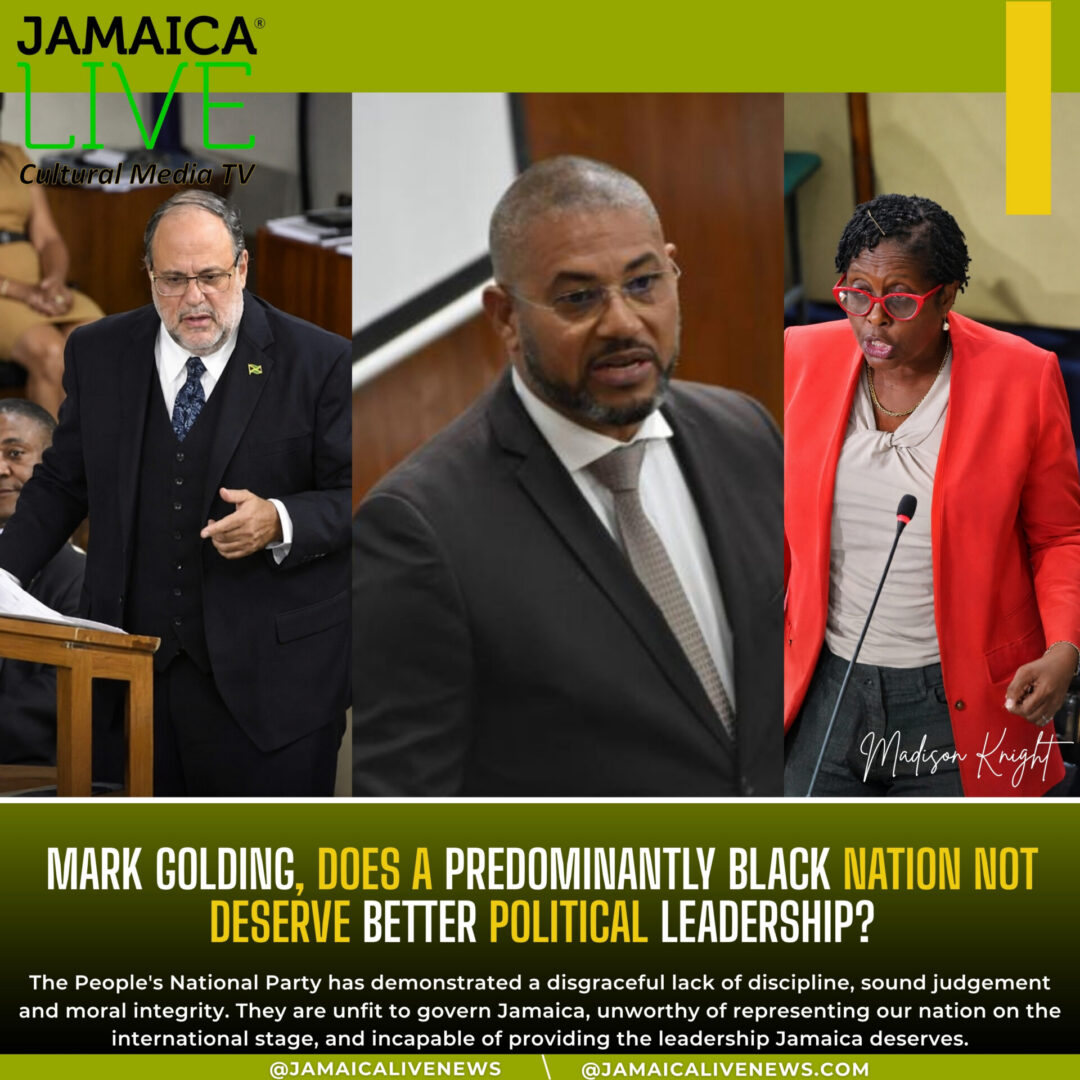
What unfolded inside Gordon House was not simply a heated parliamentary disagreement. It was a disturbing breakdown of discipline within the nation’s highest legislative institution, involving confrontations with the Speaker of the House, aggressive exchanges between parliamentarians and elected representatives having to physically intervene to prevent further escalation.
This is the confrontational, “get wicked pan dem” brand of politics that Jamaica should be rejecting, not normalising within the institution responsible for making its laws.
At a time when Jamaica is struggling to reduce crime and violence, when families are burying loved ones and the police are working to restore law and order, the country cannot afford political leaders who demonstrate the very behaviour society is being urged to abandon.
How can we demand discipline from our children, respect for authority from our young people and peaceful conflict resolution within our communities while elected representatives engage in aggression and disorder inside Parliament?
The Jamaican people deserve a higher standard.
Angela Brown-Burke and the Confrontation with Speaker Juliet Holness
Among the most disturbing scenes from the November 3 parliamentary confrontation was the encounter between Opposition Member of Parliament Angela Brown-Burke and Speaker of the House Juliet Holness.
Video footage shows Brown-Burke out of her seat and confronting the Speaker in the parliamentary aisle as Holness was leaving the chamber. Brown-Burke is seen shouting at the Speaker, and the footage shows physical contact between the two women.
The Speaker has maintained that she was shoved. Brown-Burke has disputed deliberately pushing her.
However, the physical contact captured on video cannot simply be dismissed as an ordinary political disagreement. The circumstances surrounding that contact, including whether it was deliberate and whether it constituted an assault, warrant impartial examination.
Parliamentary convention requires members to respect the Speaker’s ceremonial entrance and departure and to keep the central aisle clear.
What gives any elected representative the right to disregard those standards, position herself in the Speaker’s pathway and engage in a physical confrontation with the presiding officer?
Brown-Burke is an experienced parliamentarian and a senior figure within the People’s National Party. She understands the significance of parliamentary procedure and the authority of the Speaker.
This is also not the first time her conduct inside Parliament has raised serious concerns.
In April 2026, Brown-Burke lifted the parliamentary mace during deliberations on the National Reconstruction and Resilience Authority Bill. The mace is the ceremonial symbol of Parliament’s authority. Following the incident, she was suspended from the remainder of the sitting.
Opposition members surrounded her during the confrontation over her removal, further disrupting parliamentary proceedings.
The November incident therefore raises a broader question about parliamentary discipline and whether repeated confrontations are being adequately addressed.
If an impartial investigation establishes that the Speaker was deliberately assaulted, the appropriate legal consequences should follow.
Political office does not place anyone above the law.
Mikael Phillips: Parliamentary Aggression and Questions About Political Vetting
The confrontation involving Opposition Member of Parliament Mikael Phillips and Government MP Desmond McKenzie presented another disturbing example of the breakdown of parliamentary discipline.
Following the adjournment of the House, Phillips became involved in a heated exchange with McKenzie. Video footage shows other parliamentarians intervening to restrain Phillips as the confrontation escalated.
The spectacle of elected representatives physically restraining another lawmaker inside Gordon House should concern every Jamaican, regardless of political affiliation.
Phillips subsequently expressed regret over his use of an expletive while maintaining that he had been provoked by remarks concerning his deceased mother.
Whatever the circumstances of that exchange, personal insults and parliamentary disagreements do not justify threatening or aggressive conduct.
There is also another serious question concerning Mikael Phillips that deserves public scrutiny.
Why was Mikael Phillips allowed to serve in Jamaica’s Parliament after being charged in 2008 with assaulting his wife during a domestic dispute?
According to a Radio Jamaica report published on October 2, 2008, Phillips, then a People’s National Party caretaker, had appeared before the Half-Way-Tree Criminal Court in connection with the alleged assault.
The available report does not establish the final outcome of those proceedings. A criminal charge is not a conviction, and the existence of an allegation does not automatically disqualify an individual from serving in Parliament.
Nevertheless, the Jamaican people are entitled to ask what became of that case and what standards of scrutiny the People’s National Party applied when selecting Phillips for public office.
At a time when Jamaica continues to confront domestic violence and violence against women, political parties must be prepared to answer questions about their vetting processes and the standards of conduct expected of those entrusted with legislative authority.
Where is the accountability, and who is responsible for ensuring that political representatives meet the standards expected of public office?
Mark Golding: Where Is the Leadership?
Mark Golding is not simply another member of Parliament. He is the Leader of the Opposition and the head of a political party seeking the confidence of the Jamaican people to form the next Government.
The conduct of his parliamentary team therefore raises legitimate questions about his judgement, discipline and political leadership.
Golding has defended the Opposition’s protest, arguing that Speaker Juliet Holness and the Government improperly used parliamentary procedures to prevent Opposition members from contributing to the debate.
The Opposition contends that the Government’s decision to close debate on its censure motion was an abuse of parliamentary procedure.
Those allegations can and should be examined.
But even if every allegation made against the Speaker were true, since when does a disagreement over parliamentary procedure justify intimidation, aggression or physical confrontation?
Golding is an attorney-at-law. He understands that Parliament operates under established rules and procedures for challenging decisions made by the Speaker.
If those procedures were violated, the appropriate response is to challenge the decision, present the evidence and pursue the remedies available under parliamentary rules.
A political grievance cannot become an excuse for physical aggression.
Leadership is not measured only by how effectively a politician attacks the Government. It is also measured by the ability to exercise sound judgement, maintain discipline and hold colleagues accountable.
The Opposition has a constitutional responsibility to scrutinise the Government. That responsibility is essential to democracy. But political opposition does not require abandoning respect for the institutions through which democratic disagreements are resolved.
If Mark Golding cannot demonstrate discipline among the parliamentary representatives he leads, why should Jamaicans have confidence in his ability to govern the entire country?
The Cuba Resolution: A Diplomatic Dispute That Exposed a Parliamentary Crisis
The political confrontation arose from Jamaica’s decision to abstain from the October 28, 2026, United Nations General Assembly resolution calling for an end to the United States economic, commercial and financial embargo against Cuba.
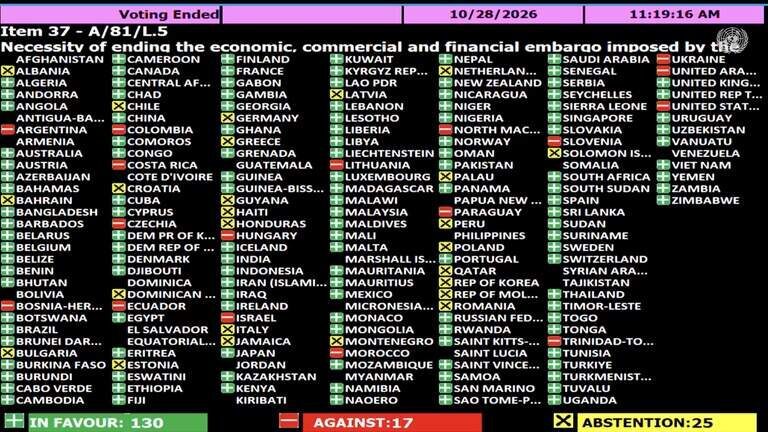
The resolution passed with 130 countries voting in favour, 17 against and 25 abstaining, including Jamaica.
Despite its passage, the United States embargo remained in place.
For more than three decades, the United Nations General Assembly has repeatedly adopted resolutions calling for an end to the embargo without compelling Washington to remove it.
These resolutions carry diplomatic significance, but they are not legally binding on the United States.
Jamaica’s abstention did not prevent the resolution from passing, and a Jamaican vote in favour would not, by itself, have ended the embargo.
This raises a fundamental question about the political judgement exercised during the confrontation.
Why should Jamaica risk its diplomatic and economic interests over a non-binding resolution that has failed to compel a change in American policy for decades?
Jamaica is a sovereign nation, but sovereignty does not eliminate the consequences of foreign-policy decisions.
Small countries operate within an international system in which economic, military and diplomatic power are unequally distributed. Responsible leadership requires careful consideration of national interests, diplomatic relationships and the potential consequences of international decisions.
This does not mean Jamaica must abandon its principles or surrender its independence. It means that foreign policy requires judgement, pragmatism and an understanding of geopolitical realities.
The Government, through Foreign Affairs Minister Kamina Johnson Smith, has maintained that Jamaica remains opposed to unilateral measures inconsistent with the United Nations Charter while questioning the effectiveness of repeatedly supporting the same resolution without improvements in Cuba’s humanitarian circumstances.
The Opposition, meanwhile, argued that the Government failed to inform Parliament adequately about its departure from Jamaica’s longstanding voting position.
Opposition MP Anthony Hylton introduced a censure motion seeking an explanation of the decision-making process, including who authorised Jamaica’s abstention and when the relevant instructions were issued.
The dispute escalated after Leader of Government Business Floyd Green moved to close the debate, prompting Opposition members to protest that they had been denied an opportunity to speak.
These questions about parliamentary transparency and procedure deserve examination.
However, the legitimacy of a political grievance must never be confused with permission to engage in disorder or physical aggression.
The resolution passed. Jamaica’s abstention did not prevent its adoption. The American embargo remained.
What did the Jamaican people gain from the confrontation that followed?
A Nation Struggling with Violence Deserves Better
The most troubling aspect of the November 3 confrontation is the example it sets for Jamaican society.
Jamaica has spent decades confronting the devastating consequences of violence. Families have lost loved ones, communities have suffered and successive governments have invested enormous resources in restoring public safety.
Political leaders regularly call upon citizens to respect the law, exercise restraint and resolve disputes peacefully.
Those same standards must apply inside Parliament.
We cannot condemn violence in our communities while making excuses for aggression within the nation’s legislature.
We cannot demand accountability from ordinary Jamaicans while lowering the standard for those who hold political office.
And we cannot teach young people that violence is unacceptable while allowing elected representatives to treat political confrontation as an acceptable substitute for reasoned debate.
Jamaica is a predominantly Black nation with a proud history of struggle, achievement and extraordinary international influence.
Its people have contributed to global culture, politics, sport, education and intellectual life far beyond the country’s geographical size.
That nation deserves political representatives who reflect its dignity and understand the responsibilities attached to public office.
The events of November 3 should be subjected to impartial parliamentary scrutiny, with appropriate disciplinary measures where misconduct is established and police investigation wherever the evidence warrants it.
The same standards must apply to Government and Opposition members alike.
The People’s National Party has every right to challenge the Government. But it also has a responsibility to demonstrate the discipline, judgement and respect for democratic institutions expected of a party seeking national leadership.
Mark Golding, if you want to lead Jamaica, demonstrate that you can lead the people already under your political leadership.
The United Nations resolution passed. The American embargo remained. And Jamaica’s Parliament was left confronting the consequences of its own disorder.
The Jamaican people deserve better.
Jamaica Live Editorial Commentary
This article presents Jamaica Live’s editorial assessment of the November 3 parliamentary confrontation. Disputed allegations of criminal conduct are distinguished from the events documented in public reporting and video footage.