

Vaz Turns the Clock Back on Golding: 2000 Squatter Dispute Resurfaces Amid Cooper’s Pen Controversy
Jamaica Live News Desk– | Aug 13, 2026
KINGSTON, Jamaica — Minister of Science, Energy, Telecommunications and Transport Daryl Vaz has turned to the newspaper archives in an attempt to challenge Opposition Leader Mark Golding’s position on the demolition controversy in Cooper’s Pen, Trelawny, accusing the People’s National Party (PNP) president of politicising the plight of affected residents while ignoring his own history on the contentious issue of squatting.
Vaz produced decades-old newspaper material concerning a bitter dispute over plans to relocate squatters from Mona Commons to lands near the Sir John Golding Rehabilitation Centre and Elletson Flats in St Andrew.

His argument is straightforward: Golding’s current posture should be examined against the position he took when a squatter-relocation controversy came much closer to home.
And contemporary newspaper reports show that Golding was not merely connected to an organisation opposing the development — he was personally present among demonstrators protesting the proposed relocation.
The controversy dates back to 2000, when the Government planned to relocate residents of Mona Commons, an informal settlement located near the University Hospital of the West Indies, to lands in the Mona and Elletson Flats area.
A Jamaica Gleaner report published on Monday, October 23, 2000, captured just how explosive the issue had become. More than 100 residents packed the Elletson Flats Community Centre for a meeting with then PNP Member of Parliament Colin Campbell, while approximately 15 police officers and soldiers arrived amid the increasingly heated confrontation.
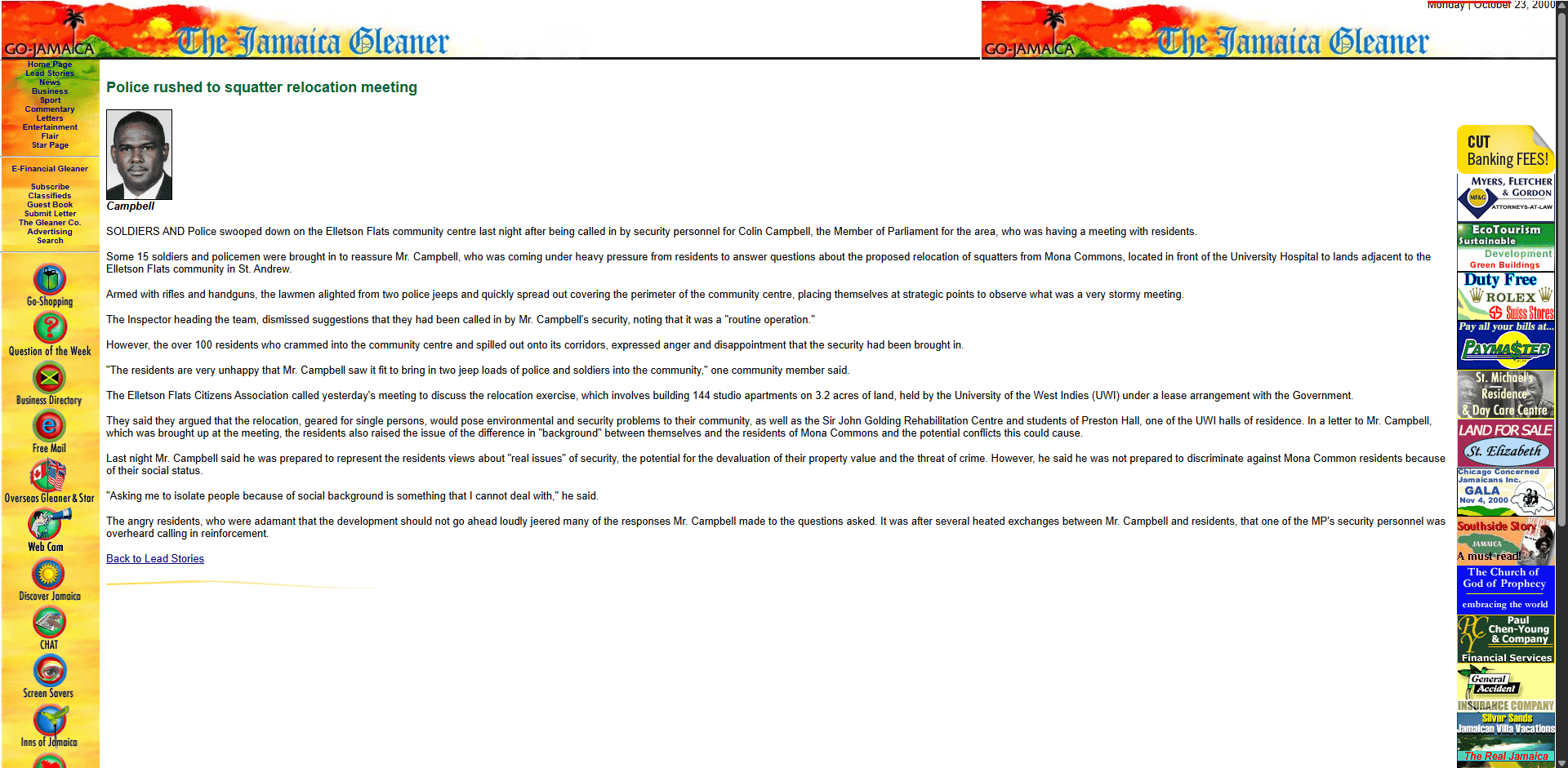
Residents raised objections ranging from security and environmental concerns to the potential devaluation of their properties. The Gleaner also reported that a letter from residents raised concerns about differences in the “background” of the two communities and the potential conflicts they believed could result.
Campbell, himself a PNP parliamentarian, pushed back against that aspect of the opposition.
While acknowledging what he described as legitimate concerns surrounding security, crime and property values, Campbell said he would not support discriminating against the Mona Commons residents because of their social status.
“Asking me to isolate people because of social background is something that I cannot deal with,” Campbell said at the time.
But another Jamaica Gleaner report, dated Tuesday, November 23, 2000, provides an even more direct connection between the controversy and the man who would later become Opposition Leader.
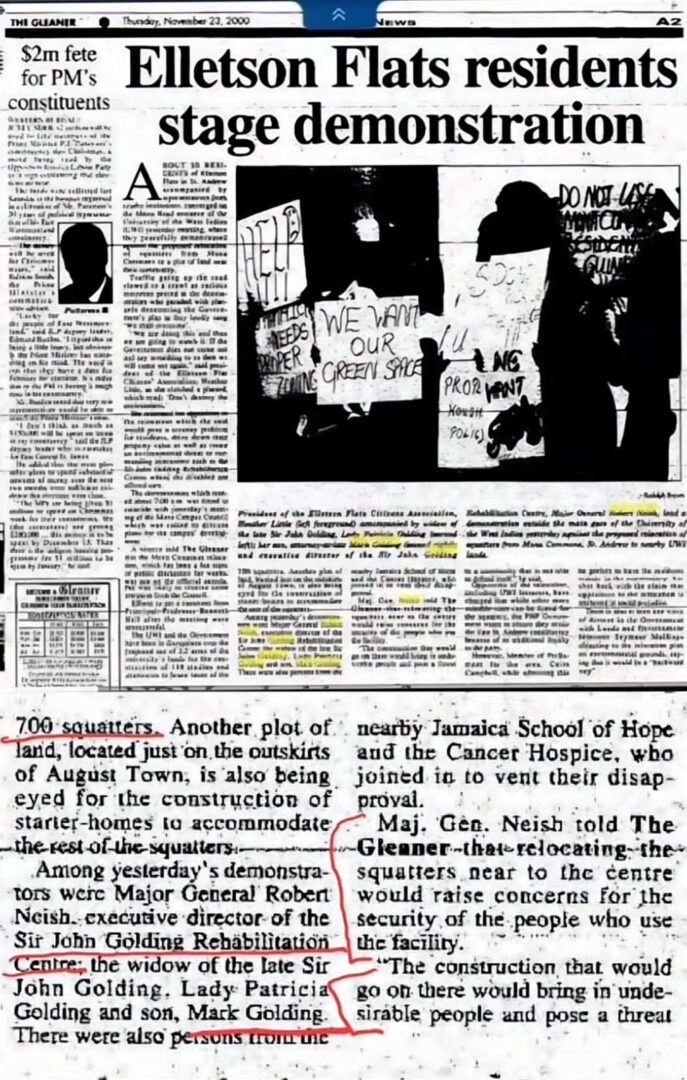
Under the headline “Elletson Flats residents stage demonstration,” The Gleaner reported on another protest against plans to relocate squatters to the area.
Crucially, the newspaper specifically identified Mark Golding and his mother, Lady Patricia Golding, widow of the late Sir John Golding, as being among the demonstrators.
The report stated:
“Among yesterday’s demonstrators were Major General Robert Neish, executive director of the Sir John Golding Rehabilitation Centre; the widow of the late Sir John Golding, Lady Patricia Golding and son, Mark Golding.”
That historical detail significantly strengthens Vaz’s argument. Golding was not simply associated with an organisation that subsequently challenged the development through the courts. According to the contemporary Gleaner report, he personally participated in a demonstration opposing the proposed relocation of squatters.
The November 2000 article reported that plans were being considered to accommodate approximately 700 squatters, including through the construction of starter homes.
The language surrounding the opposition was also striking.
Major General Robert Neish, then executive director of the Sir John Golding Rehabilitation Centre, was quoted by The Gleaner as warning that relocating squatters near the facility would raise security concerns for people using the centre.
The newspaper further quoted Neish as saying:
“The construction that would go on there would bring in undesirable people and pose a threat…”
The significance of the report is difficult to ignore in the context of the present political debate. Golding, whose father Sir John Golding founded the rehabilitation centre that bears his name, was physically present among those demonstrating against the relocation project, according to The Gleaner’s reporting at the time.
The dispute did not end with demonstrations.
Court records from the subsequent University of the West Indies v Mona Rehabilitation Foundation case show that Golding, then chairman of the Mona Rehabilitation Foundation, provided affidavit evidence in proceedings concerning the proposed relocation.
The Foundation obtained an injunction restraining the use of land within a specified distance of its medical facilities for residential purposes, particularly for housing people being relocated from Mona Commons. The court record also noted that the Foundation had no proprietary interest in the particular parcel where the housing development was proposed.

That history is now being thrust back into Jamaica’s political debate by Vaz as he accuses Golding of adopting a markedly different posture when discussing the situation in Cooper’s Pen.
Vaz argues that Golding and the Opposition have sought to portray the Cooper’s Pen demolitions as a Government failure without adequately acknowledging the legal and private-property dimensions surrounding the dispute. He has also argued that the matter deteriorated under a previous PNP administration.
The controversy has reignited a much broader and politically uncomfortable question for Jamaica: What responsibility does the State have to informal settlers, and where should that responsibility end when privately owned land and court decisions are involved?
Golding has more recently taken a strong public position in defence of informal settlers facing displacement. In April 2022, during another land dispute involving residents of Little Bay and Brighton in Westmoreland, Golding argued that the Government could not simply abandon residents because they did not possess legal title.
“The Government must intervene,” Golding told residents at the time, arguing that long-term occupation and investment in their homes could not simply be ignored.
It is precisely that contrast that Vaz is now seeking to place before the Jamaican public.
The historical evidence now goes beyond establishing that Golding chaired the Mona Rehabilitation Foundation and that the Foundation opposed the proposed development through the courts. A Jamaica Gleaner newspaper report from November 21, 2000, explicitly names Mark Golding and his mother, Lady Patricia Golding, among those who participated in the demonstration against the proposed relocation of squatters.
For Vaz, the newspaper clippings are therefore more than pieces of political nostalgia. He is presenting them as evidence of what he considers a glaring contradiction between the Opposition Leader’s current advocacy for informal settlers and his own participation in opposition to a squatter-relocation project more than two decades ago.
The Cooper’s Pen controversy may be unfolding in 2026, but Vaz has ensured that Jamaica’s political argument over it now stretches all the way back to 2000.
And with the old newspaper reports and court records resurfacing, the question being put to Golding is no longer only what he believes should happen to the residents of Cooper’s Pen today.
It is also whether the principles being championed today are consistent with the position he was prepared to publicly demonstrate for 26 years ago.